Phone: +91-9310885321
 Email: support@learnhub4u.com

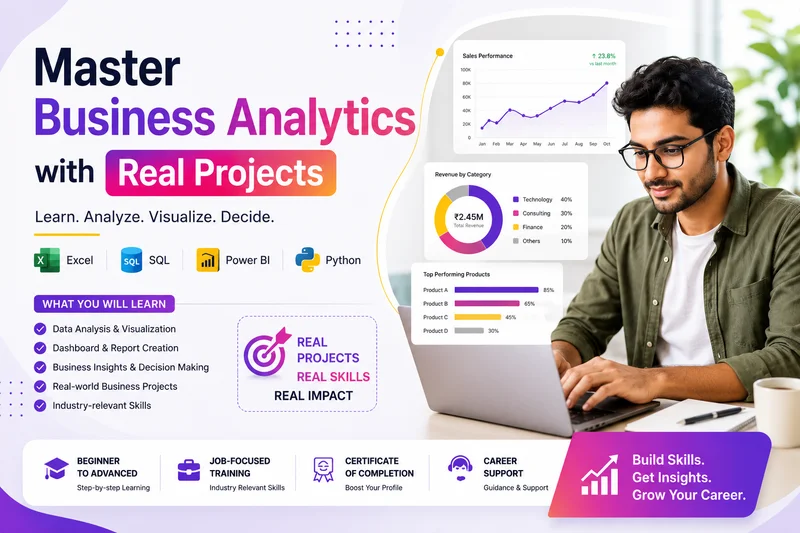
The Only Real Way to Learn Business Analytics
Let's be completely honest for a second. You can sit through a million hours of university lectures, memorize every statistical formula in the book, and pass your exams with straight As, but none of that means you actually know how to do business analytics.
The truth is, nobody ever got good at this job by staring at a PowerPoint slide.
You can watch someone code in Python on YouTube all day long, but until you are sitting by yourself at 11 PM, staring at a massive, broken Excel spreadsheet that makes absolutely zero sense, you haven't actually started learning. You only learn business analytics when you start breaking things and figuring out how to fix them. That means doing real projects.
Why Your Homework is Lying to You
In college, professors give you datasets that are pristine. They are perfectly clean, there are no missing dates, and the prompt basically tells you exactly which button to click to get the answer. It’s paint-by-numbers.
But out in the real world? Real business data is incredibly messy. It is full of duplicates, typos, and random columns named things like "test_data_v3_dont_delete."
When a company hires an analyst, they aren’t paying you because you know how to write a textbook SQL query. They are paying you to solve a mystery. They want to know why sales dropped in April, or why users are downloading their app but deleting it three days later. Projects teach you how to deal with that chaos and find actual answers.
Three Projects That Actually Look Good on a Resume
You don’t need an official corporate internship to get your hands dirty. You just need an internet connection and some curiosity. If you want a structured place to learn this without the boring academic fluff, Learnhub Education runs hands-on programs that skip the theory and put you straight to work on actual industry problems.
Whether you study on your own or through a program like Learnhub, here are three project ideas you should build right now:
1. The Customer Churn Mystery
Go onto a site like Kaggle and download a free dataset from an online retail store or a subscription service. Your goal is to figure out why customers are quitting. Use Python or R to calculate the "churn rate" (the percentage of people who leave). Look for the hidden stories. Do people who use a discount code stay longer, or do they leave the second they have to pay full price? Write up a quick, three-slide presentation for a imaginary CEO explaining what you found and how to stop the bleeding.
2. The Interactive Manager Dashboard
Find some messy sales data spread across three or four different spreadsheets. Use Power BI or Tableau to connect them all into one place. Clean up the errors, link the tables, and build a visual dashboard. Make it so a manager can click a button, filter by "Region" or "Product Type," and instantly see who is making money and who is failing. Put a live link to this dashboard right at the top of your resume.
3. The Supply Chain Fix
Snag some delivery or shipping logs. Use SQL to figure out where a company is losing time and money. Calculate how long it takes packages to leave the warehouse. Maybe you notice that a specific fulfillment center always lags behind on Friday afternoons. Write a one-page summary showing how rearranging delivery routes or staffing could save the business 15% on gas and shipping costs.
Stop Talking About Code, Start Talking About Money
Here is the biggest mistake students make: they finish a project, dump the code on GitHub, and write a summary that says, "I built a linear regression model in Python."
Recruiters don't care about that. They want to know the business value.
Instead of saying you built a model, tell them what the model did. Try phrasing it like this: "I analyzed an unorganized real estate dataset and built a predictive model that caught undervalued properties 10 times faster than manual searching."
Managers care about saving time, cutting costs, and making money. If your project description explains how you did one of those three things, you will get interviews.
Just Start Digging
It is totally normal to feel completely lost when you start your first project. Your code will break, your data won't load, and you'll spend two hours searching Google just to fix a single typo. Welcome to the job. That is exactly what real analysts do every single day.
If you want to speed up this whole process and avoid hitting a brick wall by yourself, check out Learnhub Education. It’s built for students who want to bridge the gap between academic theory and the actual skills companies pay for, giving you the exact kind of project-based guardrails you need to build a portfolio.
Stop reading chapters in a textbook. Find a messy dataset, pick a tool, and start figuring it out. That's how you actually become an analyst.
FAQs
1. Which tool should I learn first: Python, R, or SQL?
Start with SQL. Hands down. Every single company has data stored in databases, and SQL is the only way to get it out. Python and R are great for advanced coding and modeling, but if you can’t pull the data using SQL first, you won’t even get a chance to use those other tools.
2. Can I actually get a job just by doing projects online?
Yes, but only if your projects solve real business problems. Recruiters don’t care if you copied a famous tutorial project that thousands of other students have on their resumes. They want to see that you downloaded a messy dataset, found a problem, and figured out a way to solve it on your own.
3. How messy is "real-world data" anyway?
It's an absolute nightmare. In school, you get nice Excel files with everything perfectly labeled. In a real job, you will find dates formatted five different ways, missing customer IDs, typos, and duplicate rows. You will easily spend about 70% of your time just cleaning up the data before you can even start analyzing it.
4. Do I have to learn both Tableau and Power BI?
Nope, just pick one and get really good at it. They basically do the same thing, which is turning data into charts and dashboards. Once you understand the logic behind building a good dashboard in Tableau, you can pick up Power BI in a week or two if a company requires it.
5. What do platforms like Learnhub Education actually do for me?
They basically save you from getting stuck in "tutorial hell." When you study completely alone, it’s easy to get overwhelmed or give up when your code breaks. Platforms like Learnhub Education give you structured, real-world projects and actual guidance so you aren't just staring at a blank screen wondering what to build next.
6. How long does it take to learn the basics and get job-ready?
If you are consistent and spend a few hours a day practicing, you can build a solid foundation and a decent portfolio in about 4 to 6 months. It’s not something you can master in a weekend boot camp, but you also don't need a four-year degree to get your foot in the door.
7. Is Excel dead? Should I just skip it?
Absolutely not. No matter how advanced a company is, or how much they talk about AI and big data, the business world still runs on Excel. You don't need to know every single feature, but you absolutely must be comfortable with VLOOKUPs, XLOOKUPs, and Pivot Tables.
8. What is the biggest mistake students make on their portfolios?
They explain how they did something instead of why they did it. Don't just list the coding libraries you used. Tell the reader what the data revealed and how it could help a business make more money or save time. Managers read portfolios, and managers care about the bottom line.
9. Do I need a master's degree to get a high-paying analyst job?
Years ago, maybe, but not anymore. Companies have realized that a portfolio showing real skills matters way more than a piece of paper. If you can prove during an interview that you can clean data, write SQL, and talk to stakeholders, nobody is going to care about your degree.