Phone: +91-9310885321
 Email: support@learnhub4u.com

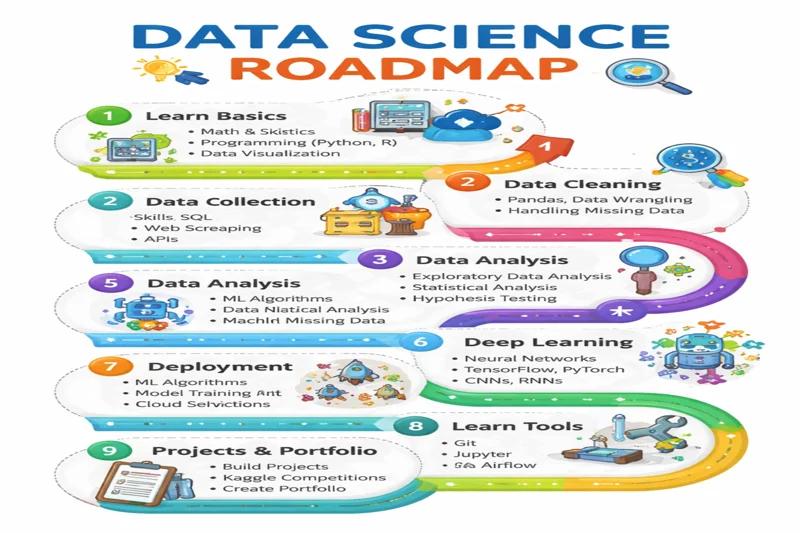
The "Data Science Roadmap" you’ll find on most blogs today is, frankly, a relic. If you’re still obsessing over the Titanic dataset or spending three months memorizing the manual math behind a Decision Tree, you’re training for a job market that closed its doors in 2023. By 2026, being a "Data Scientist" has morphed into being an AI Architect who actually understands how a business makes a profit.
At Learnhub Education, we’ve seen the shift firsthand. Companies don’t want a human calculator anymore; they want someone who can bridge the massive gap between a raw database and a deployed, agentic AI system. This isn't just a learning path—it’s a tactical overhaul of your entire skill set.
The "Gut Check" Fundamentals
You cannot skip the basics, but you must learn them through the lens of auditability. In 2026, AI writes the code. Your job is to make sure that code isn't hallucinating or riddled with security holes.
Python with a "Co-Pilot" Twist: Sure, learn the syntax. But the real skill is "Prompt Engineering for Logic." Can you use an LLM to generate a complex data cleaning script and then immediately spot where it failed to handle a null value? That’s the 2026 benchmark.
The SQL Grudge Match: Data hasn't gotten smaller; it’s just gotten more fragmented. You need to be a wizard in Snowflake or BigQuery. If you can’t write a recursive CTE or optimize a query that’s burning through a company’s cloud budget, you won't survive the first technical round.
The "BS" Filter (Applied Stats): We are drowning in synthetic data. You need to be the person who understands Causal Inference. It’s no longer about "is there a correlation?" but "did Action A actually cause Result B?"
The Infrastructure Obsession
A data scientist who can’t move their own data is essentially a researcher with no impact. At Learnhub Education, we drill into the "Plumbing" because that’s where the high-paying jobs are hiding.
Polars over Pandas: For massive datasets, Pandas is just too slow. Polars has become the industry darling for 2026. If you haven't made the switch, your workflows will look amateurish to modern lead engineers.
The Transformation Layer (dbt): You must master dbt. The ability to take a "swamp" of raw data and turn it into a clean, tested, and version-controlled "Gold" table is what separates the juniors from the six-figure seniors.
Data Observability: Learn to monitor "data rot." When a model starts acting weird, it’s usually because the input data changed in a way no one noticed. Learn to build the "alarms" that catch this.
The Generative AI Frontier
This is the meat of the 2026 roadmap. If this isn't in your portfolio, you’re invisible to recruiters.
RAG (Retrieval-Augmented Generation): This is the single most important skill right now. You need to know how to connect a massive LLM to a company’s private, messy PDF files or SQL databases using Vector Databases like Pinecone or Weaviate.
Vector Embeddings: Understand the math of "meaning." How does an AI know that "King" is related to "Man"? Once you grasp embeddings, you can build search engines that actually work.
Agentic Workflows: We’ve moved past simple chatbots. You need to build "Agents" that can use tools—AI that can check the weather, query a database, and write a summary report without a human holding its hand.
MLOps or "Stop Living in Jupyter" (Months 8–9)
If your code only runs on your local machine, it’s a hobby, not a professional product.
Docker is Non-Negotiable: You don’t need to be a full-blown DevOps engineer, but you must be able to wrap your model in a Docker container. If it’s not "portable," it’s not production-ready.
APIs with FastAPI: Stop just showing graphs. Build an endpoint. Let other software "talk" to your model. This demonstrates you understand the full software development lifecycle.
Experiment Tracking (MLflow): In 2026, discipline is everything. Use MLflow to track every version of your model. Showing a recruiter a history of your experiments proves you have a scientific methodology, not just "luck."
The "Human" Moat (Soft Skills & Strategy)
As AI takes over the "doing," humans must take over the "deciding." This is where Learnhub Education focuses on making you irreplaceable.
Data Storytelling: Can you explain a complex model to a CEO who hasn't looked at a spreadsheet in five years? If you can’t translate "p-values" into "profit margins," your technical skills are useless.
Industry Deep-Dives: Don't just be a "Data Scientist." Be a "FinTech Data Scientist" or a "HealthTech Data Scientist." Understanding the specific "unit economics" of your field is the only way to avoid being replaced by a generalist AI.
The 2026 Portfolio Checklist: Quality > Quantity
Recruiters are tired of seeing the same five projects. To stand out, your portfolio needs to look like a "Product Gallery," not a homework folder.
The Live RAG App: Build a tool that answers questions about a specific technical niche (like medical research papers) using a live Vector DB.
The Automated Pipeline: Show a project where data is scraped, cleaned via dbt, and visualized in a real-time Streamlit dashboard.
The "Why it Failed" Case Study: Write a genuine post about a project that bombed. Explain the bias you found, the data leakage you missed, and how you fixed it. That level of honesty is incredibly rare and highly valued.
Why Learnhub4u Education is the Right Choice
The 2026 market is brutal for people who just "know stuff." It is wide open for people who can "build stuff." At Learnhub Education, we don't just hand you a certificate; we hand you a toolkit of real-world battle scars. Our curriculum is built on the messy reality of production-level data science.
We don't teach you to follow a recipe; we teach you how to be the chef in a kitchen that’s constantly on fire. The tools will change by next month, but the logic and the engineering mindset we instill at Learnhub will last your entire career.
FAQs
I’ve gathered these based on the actual anxieties and hurdles beginners face, written the way a mentor would tell you over coffee.
Do I actually need a PhD to get hired in 2026?
No. While R&D roles still love them, most "Applied Data Science" jobs care more about your GitHub and your ability to solve a business problem than a thesis.
Is AI going to take all the entry-level jobs?
It’s changing them, not taking them. You won't be hired to write boilerplate Python (AI does that now); you’ll be hired to validate if the AI’s output is actually statistically sound.
Should I learn R or Python?
In 2026, the answer is Python. R is beautiful for academic stats, but the entire AI ecosystem is built on Python. Don't split your focus.
How much math do I really need?
You don’t need to be a mathematician, but you do need to understand "why" a model fails. If you don't understand what a "p-value" or "gradient descent" is, you're just a script-monkey, not a scientist.
Can I learn this in 3 months?
Honestly? Probably not. You can learn the tools in 3 months, but developing the "data intuition" usually takes 6–12 months of consistent practice.
What’s the biggest mistake beginners make?
Spending too much time on "tutorial hell" (watching videos) and not enough time building projects from scratch with messy, "gross" data.
Is the "Titanic Dataset" still a good portfolio project?
No. Please, for the love of data, don't put the Titanic or Iris dataset on your resume. It tells recruiters you just followed a 10-minute YouTube tutorial. Find unique data.
Do I need a fancy GPU laptop?
Not starting out. Use Google Colab or Kaggle Kernels for free cloud GPUs. Save your money until you’re building massive local models.
What is "RAG" and why is everyone talking about it?
Retrieval-Augmented Generation. It’s basically giving an LLM a "library" of your own data to look at before it answers. It’s the hottest skill in the job market right now.
Is Excel still relevant?
Yes. In many corporate settings, Excel is still the "universal language." Don't be too proud to use it for quick-and-dirty analysis.