Phone: +91-9310885321
 Email: support@learnhub4u.com

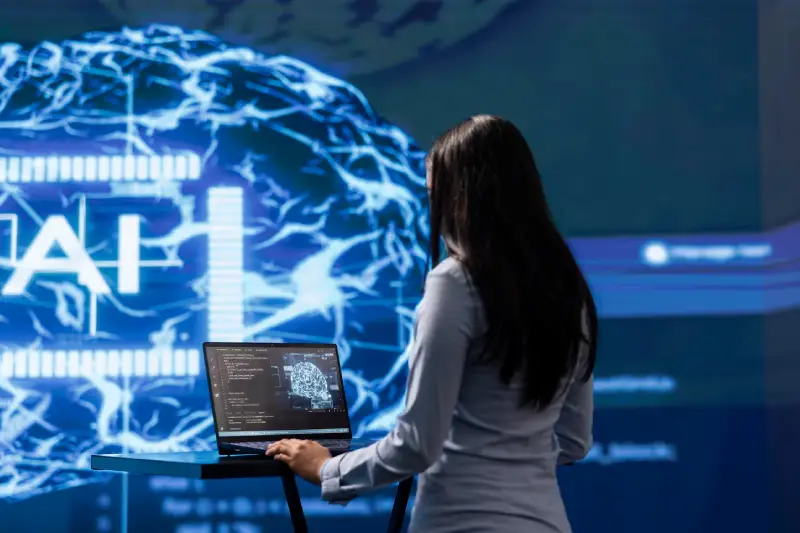
What It Actually Means for Us
I still remember when data science mostly meant one thing: prediction. If you were working on a project, the goal was usually straightforward. Forecast sales. Detect fraud. Predict churn. Build a classification model. Improve accuracy by 2–3%. That was success. Then suddenly, somewhere around the last few years, everything shifted. Instead of just predicting numbers, models started writing paragraphs. Instead of just classifying images, they started creating them. Instead of assisting analysis, they began generating code. And honestly, for many of us in data science, it felt both exciting and slightly uncomfortable at the same time. Because this wasn’t just a new library update. This was different.
Data Science Used to Be About Looking Back
Traditionally, our job was to look at historical data and extract patterns from it. You collected data. You cleaned it. You explored it. You engineered features.
You trained a model. You evaluated it. You deployed it. It was systematic. Almost procedural. Most machine learning work fell into a few familiar buckets:
Regression
Classification
Clustering
Time series forecasting
Even deep learning, for a long time, was still predictive. It recognized objects. It transcribed speech. It detected anomalies. But generative models don’t just analyze patterns. They produce new ones. And that’s where things start to feel different.
The First Time It Felt Real
I think for many professionals, the shift became real when generative models started writing usable code. Not perfect code. Not production-ready every time. But usable. You type a problem statement. It gives you a function. Sometimes even optimized. That changes workflow immediately. Earlier, if I wanted to test an idea, I would:
Think through logic.
Write boilerplate code.
Debug syntax errors.
Refactor structure.
Now? I describe what I need and refine from there. It doesn’t remove thinking. But it changes where effort goes. Instead of spending time remembering exact syntax for a specific library function, I spend more time thinking about whether the approach itself makes sense. That shift is subtle but important.
Generative AI Is Not “Magic.” It’s Pattern Learning at Scale.
There’s a lot of hype around generative AI. Words like revolutionary, disruptive, transformative get thrown around casually. Underneath all that noise, what’s actually happening is something grounded in data science fundamentals. These models are trained on massive datasets. They learn probability distributions.
They predict the next token, pixel, or sequence. They optimize loss functions. It’s still math. It’s still statistics. It’s still optimization. The scale is bigger. The architecture is more complex. But the foundation? Very familiar to anyone with a machine learning background. That’s why data scientists are uniquely positioned here. Because beneath the marketing language, we understand what’s actually going on.
The Workflow Is Changing — Quietly
One of the biggest impacts of generative AI in data science isn’t flashy. It’s operational. Data cleaning scripts can be drafted faster.
Exploratory analysis summaries can be generated quickly. SQL queries can be structured in seconds. Documentation can be drafted without staring at a blank screen. It doesn’t eliminate work. It reduces friction. And friction, if we’re honest, has always been a big part of real-world projects. Most data science jobs aren’t glamorous model-building marathons. They involve messy datasets, unclear requirements, and tight deadlines. If generative tools reduce some of that friction, that’s not trivial. It changes productivity.
But Here’s the Part People Don’t Talk About Enough
Generative AI is impressive. It is not reliable without oversight. It can confidently produce incorrect answers. It can generate biased outputs. It can hallucinate references. It can oversimplify complex logic. And this is where experienced data scientists matter more than ever. Because knowing when something “looks right but feels wrong” is not something you automate easily. You need foundational understanding:
Statistics
Model evaluation
Bias detection
Data leakage awareness
Validation frameworks
Without those, generative tools can create more problems than they solve.
Synthetic Data Is a Bigger Deal Than Most People Realize
There’s another area where generative AI is quietly reshaping data science: synthetic data. In industries like healthcare and finance, access to real data is heavily restricted. Privacy concerns are real. Compliance is strict. Generative models can create realistic synthetic datasets that preserve statistical properties without exposing sensitive records. That opens up experimentation. It allows testing pipelines. It enables training in secure environments. It reduces regulatory risk. This may not trend on social media. But inside organizations, it’s significant
Is This the End of Traditional Data Science Roles?
This question comes up constantly. Will generative AI replace data scientists? Here’s my honest take: it will replace certain tasks. Repetitive coding? Reduced.
Basic reporting summaries? Automated. Template-based analysis? Accelerated. But defining business problems? Interpreting ambiguous stakeholder requirements? Choosing appropriate evaluation metrics? Designing experiments? Ensuring ethical compliance? Those are deeply human responsibilities. If anything, the role becomes more strategic. Less time typing. More time thinking.
The Skill Shift Is Subtle But Real
What skills matter now? Still important:
Python
SQL
Statistics
Machine learning fundamentals
Increasingly important:
Model validation
AI ethics
Prompt design
Critical reasoning
System-level thinking
Memorizing syntax matters less when tools can generate it. Understanding why something works matters more than ever. That’s the difference.
The Psychological Shift in the Field
There’s also a mindset shift happening. Earlier, building a model felt like craftsmanship. You engineered features carefully. You tuned hyperparameters patiently. Now, experimentation cycles are faster. You can prototype quickly. You can test variations faster. You can iterate rapidly. Some professionals find this empowering. Others feel uneasy like control is slipping away. Both reactions are valid. Whenever tools accelerate processes, they also change identity. And data science has always had a strong identity around technical depth. Generative AI doesn’t remove depth. But it shifts where depth shows up.
The Ethics Question Is Not Optional
With generative AI, ethical responsibility increases. Bias in training data can amplify stereotypes. Generated content can spread misinformation. AI-produced analysis can appear authoritative even when flawed. As data scientists, we can’t hide behind “the model did it.” We design systems.
We validate outputs. We decide deployment standards. Accountability remains human. If anything, ethical literacy should now be considered a core data science skill — not an optional add-on.
What I Think the Future Looks Like
If I had to guess, here’s where we’re heading: Data scientists will work alongside AI assistants daily. Model development pipelines will be more automated. Documentation and reporting will be semi-generated. Experimentation cycles will shorten dramatically. But strategic thinking will become the differentiator. Not who can code fastest. Not who can memorize the most algorithms. But who can ask better questions. Who can frame better problems. Who can evaluate outputs critically. Who understands trade-offs. That’s where value concentrates.
The Human Edge
There’s something slightly ironic about all this. The more advanced AI becomes, the more valuable human judgment feels. Generative models can produce answers. They cannot take responsibility. They cannot understand long-term organizational impact. They cannot navigate office politics. They cannot align technical decisions with human consequences. That layer remains ours. And I don’t see that changing anytime soon.
Final Reflection
The rise of generative AI in data science is not just a technical upgrade. It’s a shift in how we work. It reduces mechanical effort. It increases cognitive responsibility. It speeds up experimentation. It demands stronger judgment. For those entering the field, this is actually an exciting time. You are not just learning predictive modeling. You are entering an era where data science blends analysis, creation, automation, and ethics. And if you build strong foundations in statistics, reasoning, and problem-solving generative tools become amplifiers, not threats. Data science isn’t disappearing. It’s evolving. And like every evolution in technology, the professionals who adapt thoughtfully will shape what comes next.
FAQs
1. Is Generative AI only for highly advanced data scientists?
Honestly, no. You don’t need to be some deep learning wizard to use these tools. A lot of them are designed to be user-friendly. The bigger question isn’t whether you can use them — it’s whether you can judge what they give you. If you’ve worked with data long enough to know when something feels off, you’re already in a good position. The real skill is not building the engine, but knowing when the engine is misfiring.
2. Does this mean core data science skills matter less now?
If anything, they matter more. When a tool writes code or generates analysis in seconds, it can look impressive. But impressive doesn’t always mean correct. Without understanding statistics or how models behave, it’s easy to nod along with something that’s slightly wrong. The basics are what keep you grounded. They’re your safety net.
3. Will Generative AI make the job easier?
It might make parts of it faster. You can draft scripts quicker, summarize findings without staring at a blank screen, and test ideas rapidly. But “easy” isn’t the word I’d use. The mechanical work may shrink, but the thinking part grows. You’re still responsible for the outcome. If anything goes wrong, you can’t blame the tool.
4. So how should someone in data science respond to all this?
Probably not by ignoring it. And not by blindly trusting it either. A balanced approach works best. Try it out on smaller tasks. See where it genuinely helps. Question the outputs. Break them if you can. Over time, you’ll develop a feel for where it’s reliable and where you need to step in more carefully.
5. Is Generative AI just another tech trend that will fade away?
It doesn’t feel that way. There’s definitely hype — every new technology goes through that phase. But beyond the noise, real workflow changes are happening. Teams are experimenting. Processes are adjusting. It may not flip the industry upside down overnight, but it’s slowly becoming part of the everyday toolkit. And once something becomes routine, it usually sticks around.