Phone: +91-9310885321
 Email: support@learnhub4u.com

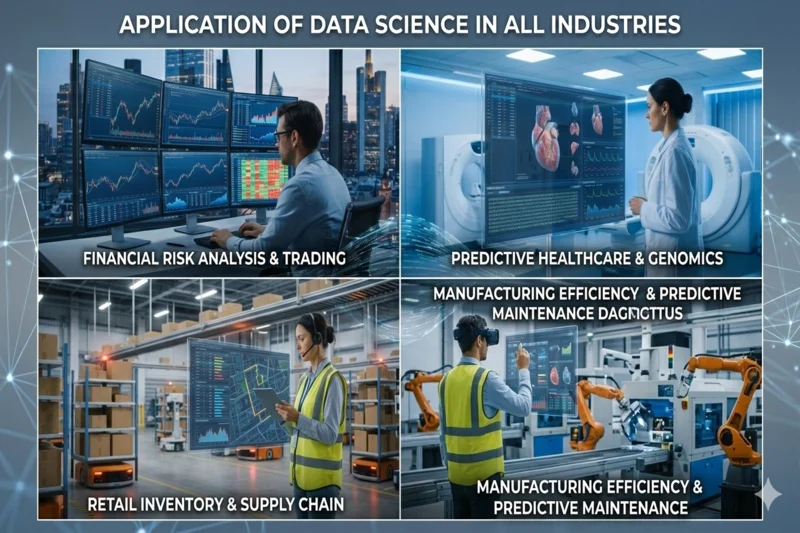
For a long time, "Data Science" felt like one of those corporate buzzwords—something whispered in boardrooms to sound expensive and sophisticated. We’ve all heard the clichés about data being the "new oil," but oil is useless until you refine it into something that actually makes a car move.
Today, we are finally seeing the refinement process. Data science has moved out of the experimental labs of Silicon Valley and into the "engine rooms" of the global economy. It’s no longer just about tech giants like Google or Meta trying to figure out which ad will make you click; it’s about how your local hospital predicts patient flow on a Monday morning, or how a logistics company keeps its trucks from breaking down on a desolate stretch of highway. If you’re looking to understand how this field is actually moving the needle in the real world, here is a deep dive into how data science is being applied across major industries right now.
Healthcare: From Reactive to Proactive
In the traditional medical model, we’ve always been reactive. You get a cough, you feel a sharp pain, or you notice a lump, and then you go to the doctor. The system reacts to the symptom. Data science is fundamentally flipping that script, moving us toward "predictive" medicine.
Predictive Diagnostics
Humans are incredible at many things, but we aren't great at looking at 10,000 X-rays and spotting a microscopic change in pixel density. Deep learning models are. By feeding massive datasets of medical imagery into neural networks, doctors can now spot early-stage tumors or neurological shifts (like those seen in Alzheimer's) years before they would be visible to the naked eye. It’s not about replacing the doctor; it’s about giving them a "superpower" lens to see what was previously invisible.
Drug Discovery
Developing a new drug is historically a nightmare. It usually takes a decade, billions of dollars, and a massive amount of "trial and error" in a wet lab. Researchers are now using data science to simulate how different molecular structures will react with proteins in the human body. Instead of testing a thousand physical samples, they can run ten million digital simulations. This doesn't just save money; it saves years of time, which—in the case of a pandemic or a rare cancer—saves lives.
Finance: The Invisible Bodyguard
The finance sector was one of the first to go "all in" on data science. Why? Because they have the cleanest, most abundant data. Money is, after all, just numbers on a screen.
Fraud Detection in Real-Time
We’ve all had that moment where our credit card gets declined while we’re traveling, followed by a quick text from the bank. That is data science in action. Every time you swipe your card, a machine learning model is running in the background. It isn't just checking your balance; it’s comparing your current purchase against your historical behavior, your physical location, and global spending patterns. If you usually buy groceries in Chicago and suddenly there’s a high-end jewelry purchase in Dubai, the system flags it in milliseconds.
Retail: The Art of Anticipation
If you feel like your favorite online store knows you better than your spouse does, you’re probably right. Retailers have moved far beyond just sending you a birthday discount. They are now in the business of "anticipatory shipping."
Inventory Optimization
Inventory is the biggest headache for any retailer. If you have too much stock, you lose money on storage; if you have too little, you lose customers. Companies like Walmart or Target use data science to predict surges in demand before they happen. They look at seasonal trends, upcoming weather events, and even local economic shifts. If a hurricane is predicted for the coast, data shows that people don't just buy water—they buy strawberry Pop-Tarts (this is a real insight from Walmart’s data). Knowing that allows them to stock the right shelves at the right time.
Recommendation Engines
Think of the "Because you watched..." section on Netflix or "Customers also bought..." on Amazon. These aren't random suggestions. They are the result of "collaborative filtering"—a process that analyzes millions of users who share your exact tastes. The system essentially says, "We found 50,000 people who liked exactly what you liked; 90% of them also liked this movie, so there’s a high probability you will too."
Logistics & Transportation: Mapping Efficiency
Getting a package from a warehouse in Shanghai to a doorstep in Seattle is a logistical miracle. It involves a staggering amount of variables: traffic, fuel costs, weather, and human fatigue.
Route Optimization
UPS is famous for using a system called ORION (On-Road Integrated Optimization and Navigation). One of the most famous insights from their data was that left-hand turns are inefficient. They cause more idling, more accidents, and more fuel consumption. By using data science to map routes that prioritize right-hand turns, UPS has saved millions of gallons of fuel and cut millions of pounds of CO2 emissions.
Predictive Maintenance
This is a game-changer for airlines and trucking fleets. Sensors on engines track heat, vibration, and pressure in real-time. Data models then flag a specific part for replacement before it fails. It is much cheaper to fix a truck during a scheduled stop than it is to tow it off a highway and deal with a missed delivery window.
Entertainment: Content by the Numbers
The "gut feeling" of a Hollywood executive is being supplemented—and sometimes replaced—by hard data.
Greenlighting Projects
Streaming platforms like Netflix don't just guess which shows to make. They analyze viewing habits to an granular degree. They don't just know what you watched; they know when you paused, when you lost interest, and what specific "vibe" keeps you watching until 2 AM. When they decided to remake House of Cards, it wasn't a gamble—they already knew their audience loved David Fincher and Kevin Spacey.
Personalized Marketing
Even the thumbnail image you see for a movie is often tailored to you. If the data shows you like romantic comedies, the thumbnail for an action movie might show the lead couple. If you prefer explosions, the thumbnail for that same movie will show a car chase. It’s the same content, just marketed to your specific psychology.
The Bottom Line
At its core, data science isn't about the math or the coding—it’s about better decision-making. It’s about removing the "I think" from a conversation and replacing it with "the data suggests." As we move forward, the "magic" of data science will become even more invisible. It will just be the way the world works. The companies and professionals who succeed won't necessarily be the ones with the most data, but the ones who know how to ask the right questions of the data they have. The gap between those who use data to drive their strategy and those who rely on "gut feeling" is no longer just a gap—it’s a canyon.
FAQs (The Real Talk Version)
1. Is data science just a fancy name for math?
Pretty much, but with a lot more coding. It’s statistics applied to massive amounts of information that a human brain literally couldn't process on its own. It’s math with a massive megaphone.
2. Is my phone actually listening to me?
Probably not, but the truth is scarier: it doesn't need to. Your digital footprint—where you go, what you buy, and who you hang out with—is so predictable that an algorithm can guess what you’re thinking about without ever hearing a word you say.
3. Will a robot take my job?
If your job is "sorting through spreadsheets and looking for errors," maybe. But for most people, it’s just a tool. It’s like how the calculator didn't kill accounting; it just made it so accountants didn't have to spend all day doing long division.
4. Why do we keep hearing about "Algorithm Bias"?
Because data comes from humans, and humans are biased. If you train a hiring bot on 20 years of data from a company that only hired men, the bot will think "being a man" is a requirement for the job. It’s a "garbage in, garbage out" problem.
5. How do I start using data in a small business?
You don’t need a supercomputer. Just look at your sales data. What’s your slowest hour? What do people buy together? Even a basic spreadsheet can show you patterns that your "gut feeling" might be missing.
6. What is "Big Data" anyway?
It’s just a buzzword for "more data than a normal computer can handle." It usually refers to information that is coming in too fast, in too many formats, or in too much volume for traditional methods.
7. Can data science predict the stock market?
If it could perfectly, the person who built it wouldn’t be telling you about it. It can predict trends and probabilities, but the market is driven by human chaos, which is the one thing that’s still pretty hard to model perfectly.
8. Is my data safe?
It depends. Companies use data science to protect your info, but hackers use it to try and find cracks in the wall. It’s a constant arms race. The best thing you can do is use MFA and be careful about what "free" apps you give permissions to.