Phone: +91-9310885321
 Email: support@learnhub4u.com

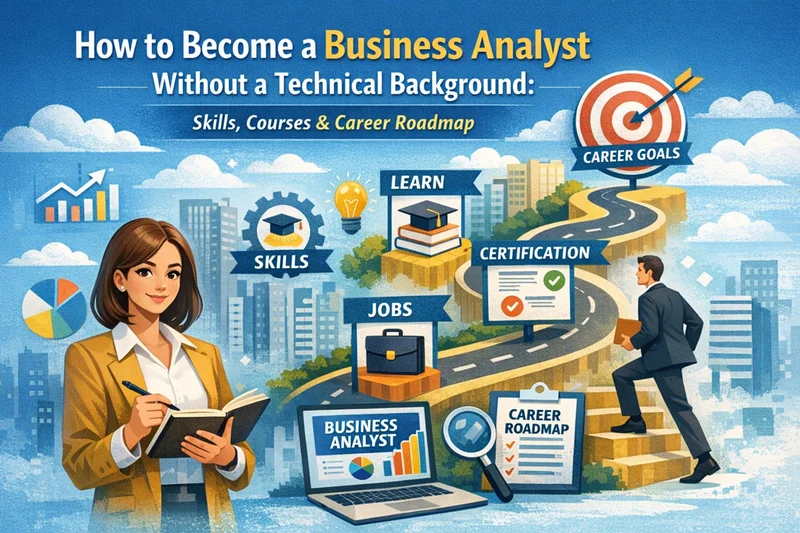
There is a persistent myth in the corporate world that to work anywhere near "data," you need to be a math whiz or a secret coder who speaks in Python script. If you’ve spent any time scrolling through job boards lately, you’ve likely seen Business Analyst (BA) descriptions that look like they’re hiring for NASA.
Here is the truth: Business Analysis is a human-centric discipline.
In 2026, as AI takes over the heavy lifting of data crunching and code generation, the "Human-in-the-loop" is more valuable than ever. Companies don’t just need people who can run a report; they need people who can explain why the report matters and what the business should do next. If you are coming from sales, teaching, healthcare, or the arts, you aren’t starting from zero. You are starting with a unique perspective. Here is your step-by-step roadmap to transitioning into a Business Analyst role without a single line of code on your resume.
The Mindset Shift: You Are a Translator, Not a Calculator
The most important thing to understand about being a BA is the "Bridge" concept. On one side of the bridge, you have the Stakeholders (the business owners, marketing teams, or CEOs) who have problems but don’t know how to fix them. On the other side, you have the Technical Teams (the developers and data scientists) who can build anything but need specific instructions.
As a BA, you sit in the middle. Your job is Translation.
Business side says: "Our checkout process is slow, and we’re losing money."
BA translates this to Tech: "We need to reduce the API latency on the payment gateway and simplify the UI from five steps to three to reduce cart abandonment by 12%."
If you are good at listening, asking "Why?", and organizing information, you already have 70% of what it takes.
Inventory Your "Stealth" Skills
You likely already possess "Transferable Skills" that a computer science graduate might lack. In the industry, we call these Elicitation and Stakeholder Management.
Empathy and Listening: Can you sit in a room with a frustrated manager and figure out what they actually need versus what they say they want? That’s Requirement Elicitation.
Conflict Resolution: When the Marketing team wants a feature that the Engineering team says is impossible, can you negotiate a middle ground? That’s Scope Management.
Domain Expertise: If you’ve worked in a warehouse for five years, you know more about logistics than a junior data scientist ever will. That industry knowledge is your "Domain Expertise," and it is your biggest competitive advantage.
The "Non-Technical" Technical Toolkit
You don’t need to be a developer, but you cannot be "tech-illiterate." Think of this as learning the local language before moving to a new country. You don't need to write poetry in it, but you need to be able to order dinner.
A. The Holy Trinity: Excel, SQL, and BI
Excel is still King: You don’t need to code, but you do need to master Pivot Tables, VLOOKUPs, and basic data cleaning. Excel is where 90% of business logic still lives.
SQL (The "Read-Only" Version): You don't need to build databases. You just need to know how to "ask" a database for information. Learning the SELECT, FROM, WHERE, and JOIN commands takes about a weekend, and it removes your dependency on developers.
Data Visualization: Tools like Tableau or Power BI are essentially "PowerPoint for data." If you can drag and drop a chart that shows a trend clearly, you’ve done your job.
Visual Documentation
BAs communicate through pictures. Learn how to create:
Flowcharts: Showing how a process works from start to finish.
Wireframes: Simple sketches of what a software screen should look like (use tools like Figma or even a whiteboard).
User Stories: Writing simple sentences like: "As a customer, I want to save my credit card info so that I can check out faster next time."
Leveraging AI as Your Technical Assistant
In 2026, the barrier to entry for non-technical people has vanished thanks to AI. You no longer need to memorize complex syntax; you need to know how to direct it.
Prompt Engineering for BAs: You can use tools like ChatGPT or Gemini to help you write SQL queries. You describe the data you have, and the AI writes the code for you.
Requirement Drafting: Use AI to create a first draft of a "Business Requirements Document" (BRD). It saves you hours of formatting and ensures you don't miss standard industry checkpoints.
The "Explain It To Me" Loop: If a developer explains a technical constraint that sounds like gibberish, ask an AI to "Explain this technical concept to a business manager." This keeps you in the conversation without feeling lost.
Certification: Building a "Bridge of Trust"
When you don't have a technical degree, certifications act as a "seal of approval" for recruiters. They prove you have the discipline to learn the formal methodology.
ECBA (Entry Certificate in Business Analysis): This is the gold standard for beginners. It’s offered by the IIBA and focuses on the logic of analysis, not the coding.
Google Data Analytics Certificate: This is a fantastic, low-cost way to get comfortable with the "data" side of things without feeling overwhelmed.
Agile/Scrum Certifications (PSM or CSM): Most modern companies work in "Sprints." Understanding the Agile framework makes you immediately hirable because you’ll know how the team functions on day one.
The "Invisible Portfolio" Strategy
How do you get experience without a job? You create it.
Stop looking for "Data Science" projects and start looking for Business Problems. Go to a local non-profit, or even look at your current job, and find something that is broken.
Identify the Pain: "Our volunteer sign-up process is manual and takes 4 hours a week."
Map the Current State: Draw a flowchart of how it works now (the "As-Is").
Propose the Future State: Draw a flowchart of how it could work with a simple automated form (the "To-Be").
Quantify the Value: "This change will save 16 hours a month, allowing us to focus on fundraising."
That is a Business Analysis portfolio piece. You didn't write code; you provided a solution.
Rewriting Your Story (The Resume Flip)
To get a BA interview, you must stop describing your past jobs in terms of tasks and start describing them in terms of outcomes.
Before (Sales Role): "I sold software to 50 clients a month."
After (BA Style): "Identified key customer pain points through gap analysis, leading to a 15% adjustment in product features and increased retention."
Before (Administrative Role): "I managed the office budget and filing."
After (BA Style): "Optimized operational workflows by analyzing expenditure data, resulting in a $5,000 monthly cost reduction."
Conclusion: The World Needs More "Human" Analysts
As we move deeper into 2026, the world is drowning in data but starving for clarity. Anyone can generate a chart with a click of a button, but very few people can tell a CEO what that chart means for the company's future. Becoming a Business Analyst without a technical background isn't about "faking it." It’s about realizing that business knowledge is the foundation, and technology is just the tool. If you can think critically, communicate clearly, and stay curious, the technical side will eventually feel like second nature. Start small. Master Excel. Learn to draw a flowchart. Ask "Why?" three times in every meeting. Before you know it, you won't just be "non-technical" you'll be the most valuable person in the room.
FAQs
1. Do I really need to learn how to code to be a "modern" Business Analyst?
The short answer: No. You don’t need to be a developer. However, you do need to be "data comfortable." In 2026, this means understanding how data is structured so you can talk to the people who do code. If you can understand basic logic (like "If this happens, then that should happen"), you have the foundational logic required for the job.
2. What is the difference between a Data Analyst and a Business Analyst?
Think of it this way:
Data Analysts spend 80% of their time with the data (cleaning it, querying it, and finding patterns).
Business Analysts spend 80% of their time with people (interviewing stakeholders, defining problems, and managing projects). A BA uses data to support a business decision, while a Data Analyst focuses on the technical accuracy of the numbers themselves.
3. I have zero experience; which certification should I get first?
If you are coming from a non-tech background, the ECBA (Entry Certificate in Business Analysis) from the IIBA is the best "door-opener." It proves you understand the formal methodology. If you want something more "hands-on" with data, the Google Data Analytics Professional Certificate is a fantastic, low-pressure way to build confidence.
4. Can I get hired if I don't have a degree in Finance or Computer Science?
Absolutely. Many companies actually prefer BAs with backgrounds in Psychology, English, or Communications because those fields produce great writers and listeners. As long as you can show you’ve solved a problem using a structured process (Identifying the issue → Analyzing options → Proposing a fix), your specific degree matters much less than your problem-solving "logic."
5. How much "Math" is actually involved in the day-to-day job?
Unless you are working in high-level Financial Modeling, the math rarely goes beyond basic statistics (averages, percentages, and trends). You won't be doing calculus. The "math" in Business Analysis is usually about logic and proportions—for example, "If we change this step in the process, will it save us 10% more time?"