Phone: +91-9310885321
 Email: support@learnhub4u.com

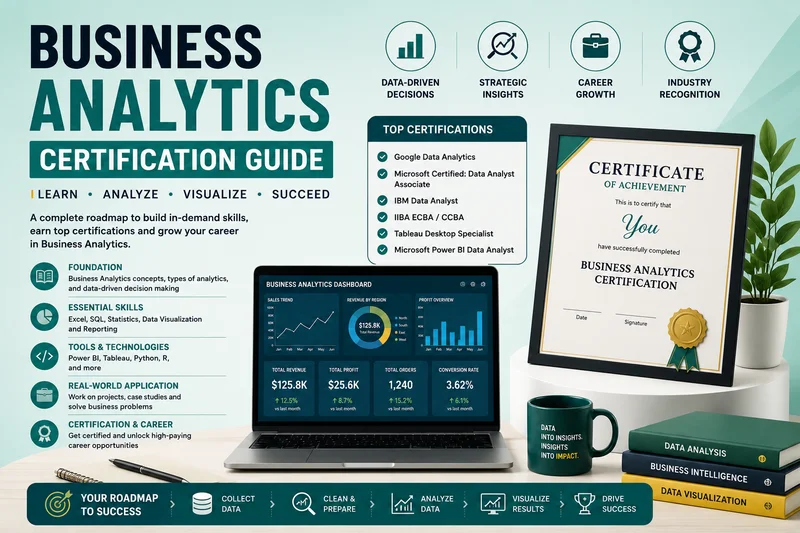
The Ultimate Guide to Business Analytics Certifications: What’s Worth Your Time and Money?
Let’s be completely honest for a second. If you look up "how to get into business analytics" right now, you are going to get hit with a wall of terrifying buzzwords. Predictive modeling. Big data querying. Statistical regression. It sounds like you need a math degree just to look at a spreadsheet.
Here is the secret: you don't.
Business analytics isn't about being a math genius. It’s about being a translator. You are the bridge between raw numbers on a screen and real-world decisions, like helping a company figure out how to stop wasting money or what products to sell next.
If you are a student or a career changer trying to break into this field, getting a certification is one of the fastest ways to prove you can do the job. But with hundreds of options out there, which ones are actually worth your time?
At Learnhub Education, we talk to hiring managers and students every single day. We know exactly what employers look for on a resume—and what just looks like filler. Let’s break down the best business analytics certifications for beginners, completely free of corporate jargon.
Why Even Get Certified? (The Brutal Truth)
Before you hand over your money to any online platform, you need to know what a certificate actually does for you.
A piece of paper will not magically land you a high-paying job tomorrow. Anyone who tells you otherwise is lying. What a certification actually does is give you two massive advantages:
First, it gets you past the "Resume Robot." Most large companies use software to scan resumes for specific keywords before a human ever looks at them. Having a recognized certification checks those boxes automatically.
Second, it forces you to build a portfolio. The best courses make you work on real projects. When an interviewer asks if you know how to analyze data, you don't just say "yes"—you can actually show them a dashboard you built yourself.
The Top Beginner-Friendly Certifications
If you are starting from absolute zero, you want a program that teaches you the foundational tools: Excel (the advanced stuff), SQL (how to talk to databases), and Tableau or Power BI (how to make charts that bosses love).
Google Data Analytics Professional Certificate
This is widely considered the best starting point for getting your foot in the door. Google designed this course specifically to take people from "I don't know what data is" to "I can get hired as an entry-level analyst."
The Good: It focuses heavily on the mindset of an analyst—how to ask the right questions and solve problems logically. It also teaches you basic coding and visual tools like Tableau.
The Bad: Because it's so popular, almost everyone has it on their resume. You have to work hard on your final project to make sure yours stands out from the crowd.
Microsoft Certified: Power BI Data Analyst Associate
If you go into business analytics, you will quickly realize that corporate companies love Microsoft. Power BI is a tool used to create interactive dashboards, and it is exploding in popularity right now.
The Good: This exam is highly respected because it’s genuinely tough. If you pass it, employers know you actually know how to clean messy data and build professional business reports.
The Bad: It is very specific to Microsoft's software. If you get a job at a company that uses a different tool, like Tableau, you'll have to relearn a few things.
Wharton Business Analytics Specialization
Unlike the Google certificate, which focuses heavily on the technical side, this program from the Wharton School of the University of Pennsylvania focuses on how data applies to real business strategy—like marketing, human resources, and finance.
The Good: It looks fantastic on a resume because Wharton is a world-class business school. It teaches you how a CEO thinks.
The Bad: It is much more theoretical. You won't get as much hands-on coding practice here as you would with other courses.
How to Choose the Right One for Your Goals
If you want a job as fast as possible and have absolutely zero tech background, go with the Google Data Analytics certificate. It builds a solid, well-rounded foundation from scratch without throwing you into the deep end.
If you care more about corporate business strategy, management, or marketing rather than staring at lines of code all day, choose the Wharton Business Analytics course. It teaches you the business impact of data.
If you already know a bit of Excel and want to focus on creating amazing visuals and reports that managers love to look at, study for the Microsoft Power BI exam.
The Learnhub Strategy: How to Actually Finish Your Course
We see a lot of students start these courses with massive enthusiasm, only to quit three weeks later when the tech side gets confusing. Here is how you actually make it through:
Stop trying to memorize everything: You do not need to memorize every single line of code or formula. Professional data analysts google things constantly. Your job is to understand how to solve the problem, not to type perfectly from memory.
Build a project about something fun: Don't wait until you're an expert to build something. Take a dataset about something you actually care about—like video game stats, music trends, or sports scores—and try to find interesting patterns. Learning by doing is the only way it sticks.
Focus on communication: In the real world, a manager doesn't care how complex your math was. They care about the answer to one simple question: "What does this mean for our business?" Practice explaining your data projects to a friend who knows nothing about tech. If they can understand it, you're ready for an interview.
Final Thoughts
The business analytics field is growing incredibly fast because companies have too much data but not enough people who know how to read it. Getting certified isn't about collecting digital badges for your LinkedIn profile; it's about building the confidence to solve real-world business puzzles.
Take it one step at a time, don't get discouraged by a few error messages, and remember that every expert analyst started exactly where you are sitting right now.
FAQs:
1. How long will it take me to finish the Google certificate?
If you can spare an hour or two a day, most students wrap it up in about 3 to 4 months. Because it is completely self-paced, you can speed through it over a college break or slow down when your semester exams get crazy.
2. Do companies actually care about these online certificates?
A certificate alone won't get you a job. It helps your resume get past the initial automatic keyword scanners, but that’s about it. In an actual interview, managers won't care about the paper—they will only care about the projects you built while earning it.
3. How much do these courses cost?
It depends on how you take them. Programs on Coursera (like the Google or Wharton courses) usually cost a monthly fee of around ₹3,000 to ₹4,000, so the faster you finish, the less money you spend. Official software exams, like the Microsoft Power BI test, charge a flat fee of around ₹11,000 to ₹13,000 to sit for the exam.
4. Should I learn Power BI or Tableau first?
The easiest trick is to open a job site like LinkedIn or Naukri and look up entry-level analyst jobs in your city. See which tool they ask for more. Generally, traditional corporate companies love Power BI because it connects easily with Microsoft Excel, while startups prefer Tableau because the dashboards look a bit cleaner.
5. What exactly is a portfolio project?
It’s just a mini-project where you act like a real analyst. You download a public dataset about something you actually like—maybe IPL match stats, Spotify streaming trends, or Zomato restaurant reviews—clean it up, find an interesting trend, and make a chart to explain it.
6. Do these certificates expire?
General platform certificates from Google or universities last forever. However, tool-specific ones, like the official Microsoft Power BI Associate certificate, expire after one year. The good news is Microsoft lets you renew it for free on their website by passing a short, open-book online quiz.
7. Which certificate is best if I want to work in marketing or finance?
Go with the Wharton Business Analytics course. While other programs spend weeks teaching you how to write lines of technical code, Wharton focuses entirely on the business side. It teaches you how companies use data to track ad budgets, manage corporate money, and predict what customers will buy next.
8. What is the biggest mistake students make in these courses?
Rushing through the videos at 2x speed just to get the certificate at the end. If you just copy-paste the project code without understanding how it works, you will completely freeze up the moment an interviewer asks you a basic technical question about it.