Phone: +91-9310885321
 Email: support@learnhub4u.com

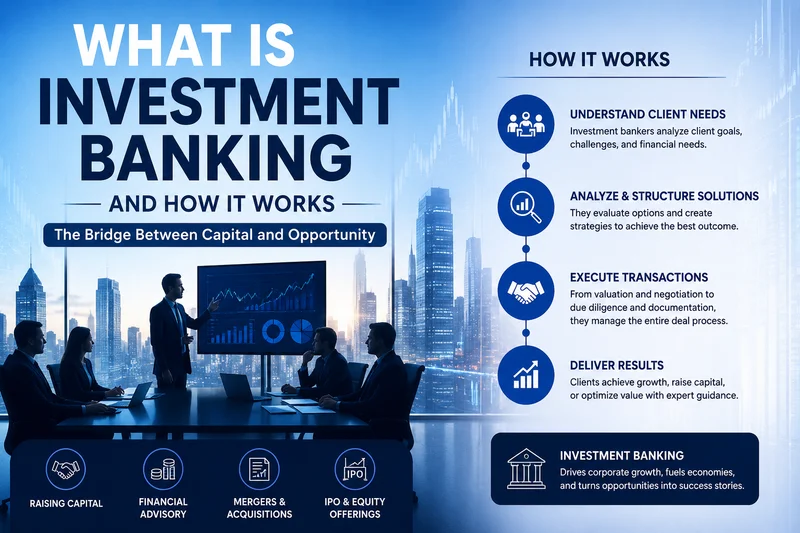
What Is Investment Banking and How It Works
If you've ever heard someone mention "investment banking" and immediately pictured a guy in a suit shouting into a phone on Wall Street, you're not entirely wrong — but you're also missing most of the picture. I remember when I first came across the term in college. I thought investment banks were just regular banks, except fancier. Turns out, that's not even close to the truth.
At Learnhub Education, we get a lot of students asking us to break down finance topics in plain language, and investment banking is probably one of the most asked-about (and most misunderstood) careers out there. So let's actually go through it properly — no jargon overload, just a clear explanation of what these institutions do and why they matter.
First Things First: It's Not a Regular Bank
When you think of a "bank," you probably think of the place where you keep your savings account, get a debit card, or apply for a home loan. That's a commercial bank or retail bank. Investment banks are a completely different animal.
An investment bank doesn't really deal with everyday people depositing paychecks. Instead, it works with big players — companies, governments, and large institutions — helping them raise money, grow, restructure, or make major financial decisions. Think less "checking account," more "helping a company sell shares to the public for the first time."
So in short: investment banks don't hold your savings. They help organizations move large amounts of money around in smart, strategic ways.
So What Do Investment Banks Actually Do?
This is where it gets interesting, because investment banking isn't just one job — it's a bunch of different functions bundled under one roof. Here are the big ones.
1. Helping Companies Raise Money
Let's say a company wants to expand, build a new factory, or just needs a large sum of cash to grow. It has two main options: borrow money (debt) or sell ownership stakes (equity). Investment banks help with both.
If a company wants to go public — meaning sell shares to everyday investors for the first time — that process is called an IPO (Initial Public Offering). Investment banks are the ones who guide a company through this, decide how the shares should be priced, and connect the company with investors willing to buy in.
If a company wants to borrow money instead, investment banks help structure and sell bonds, which are basically IOUs that investors buy in exchange for interest payments over time.
2. Mergers and Acquisitions (M&A)
You've probably heard about companies "merging" or one company "acquiring" another. These deals aren't simple — they involve negotiations, valuations, legal steps, and a ton of financial analysis. Investment bankers sit right in the middle of these deals, advising companies on what a fair price looks like, how the deal should be structured, and how to make sure everyone walks away with what they want (or close to it).
This is honestly one of the most talked-about parts of investment banking because the deals can be worth billions of dollars, and the stakes are incredibly high.
3. Trading and Market Making
Some parts of investment banks are involved in buying and selling stocks, bonds, currencies, and other financial products — either for their own clients or sometimes for the bank itself. This side of the business moves fast, relies heavily on market knowledge, and requires people who can make quick decisions under pressure.
4. Research
Before any big financial decision gets made, someone has to actually study the market, the company, and the industry. That's where research analysts come in. They dig into financial statements, industry trends, and economic data to give recommendations — basically, they're the ones doing the homework so everyone else can make smarter calls.
5. Asset and Wealth Management
Some investment banks also manage money on behalf of wealthy individuals or big institutions like pension funds. Their job here is to grow that money responsibly over time through smart investment strategies.
Why Do Companies Even Need Investment Banks?
Here's the honest answer: because raising money, buying another company, or going public is genuinely complicated. There are legal requirements, market timing issues, pricing challenges, and a hundred small decisions that can make or break a deal. Companies don't have this kind of specialized expertise in-house most of the time, so they bring in investment bankers who do this for a living.
It's a bit like hiring a really experienced real estate agent instead of trying to sell your house on your own. Sure, you could figure it out yourself, but an expert who's done it a hundred times will likely save you money, time, and a lot of stress.
A Quick Walkthrough of How a Deal Might Actually Happen
Let's make this less abstract with a simple example.
Imagine a mid-sized tech company wants to go public. Here's roughly how it plays out:
1. The company hires an investment bank (or a group of them) to manage the process.
2. The bank studies the company's financials, market position, and growth potential.
3. Together, they figure out how many shares to sell and at what price.
4. The bank helps market the company to potential investors — this is sometimes called a "roadshow."
5. On the big day, the shares finally hit the stock exchange, and trading begins.
Behind the scenes, there's a mountain of paperwork, legal review, and financial modeling. But that's the general shape of it.
Is Investment Banking a Good Career Path?
This question comes up a lot from students exploring finance careers, so it's worth addressing honestly. Investment banking can be financially rewarding and intellectually demanding — you'll work with sharp people, learn an enormous amount about how businesses and markets function, and get exposure to major financial decisions early in your career.
That said, it's also known for being intense. Long hours, tight deadlines, and high-pressure environments are pretty common, especially in the early years. It's not necessarily for everyone, but for people who genuinely enjoy problem-solving, numbers, and fast-paced work, it can be a great fit.
Wrapping It Up
Investment banking isn't as mysterious as it sounds once you break it down. At its core, it's about helping large organizations make smart financial moves — whether that's raising money, merging with another company, or navigating the stock market. It's less about personal banking and more about advising, structuring, and executing big financial decisions.
If you're a student trying to figure out whether this field is right for you, the best approach is to start small: read about real deals, follow financial news, and try to understand the "why" behind major corporate moves. That curiosity is honestly the first step toward understanding how the entire financial world fits together.
At Learnhub Education, we believe finance doesn't have to feel intimidating. Once you understand the basic building blocks — like what investment banking actually is — everything else starts to make a lot more sense.
FAQs:
1. Is investment banking basically the same as a normal bank?
Nope, not even close honestly. Like when you think "bank" you think savings account, debit card, maybe a loan for a car. Investment banks don't really do any of that stuff. They work with big companies, not regular people like us. Same word, totally different job.
2. What do these people even do all day?
Depends a lot on their exact role but a big chunk of it is building financial models, making slides/presentations for clients, and just doing a ton of research on companies. Not as glamorous as movies make it look tbh. Way more spreadsheets than drama.
3. Do I need to study finance to get into this field?
Helps for sure but it's not mandatory. I've heard of people getting in from econ, math, even engineering backgrounds. What matters more is being good with numbers and actually being interested in this stuff, not just the degree title.
4. What's an IPO in like, simple words?
It's basically when a company that used to be private decides "okay now anyone can buy shares of us." Investment banks help figure out the price and get investors interested before that day happens.
5. Why would a company even want to go public?
Mostly money honestly. They can raise a huge amount pretty fast which they can use to grow, pay off debt, whatever. Also going public kind of makes a company look more legit to people.
6. What's this M&A thing everyone talks about?
Mergers and acquisitions. So basically when one company buys another one, or two companies join together. Bankers help negotiate what a fair price even looks like and handle all the messy back and forth.
7. Why do companies pay investment banks so much money for this stuff?
Because messing up a deal costs way more than the fee. Like if you price an IPO wrong or structure a merger badly, that mistake can cost millions more than what you'd pay a bank to just do it right the first time.
8. Wait, are investment bankers the same as stockbrokers?
No, different thing. Stockbrokers deal with regular people buying/selling stock. Investment bankers work on the big company-level stuff, deals worth way more money, different clients entirely.
9. Is this job actually as stressful as people say?
Kind of yeah, especially when you're just starting out. Long hours are pretty normal and it gets intense right before a deal closes. Some people genuinely like that fast pace though, not everyone hates it.
10. What skills actually matter here?
Being comfortable with numbers, paying attention to small details, and honestly just being really good at Excel. Also being able to explain things clearly even when things are moving fast and everyone's stressed.
11. What's the difference between raising money through debt vs equity?
Debt = borrowing money you gotta pay back later (like bonds). Equity = selling a piece of ownership in the company (like shares). Companies pick depending on what makes sense for them at the time.