Phone: +91-9310885321
 Email: support@learnhub4u.com

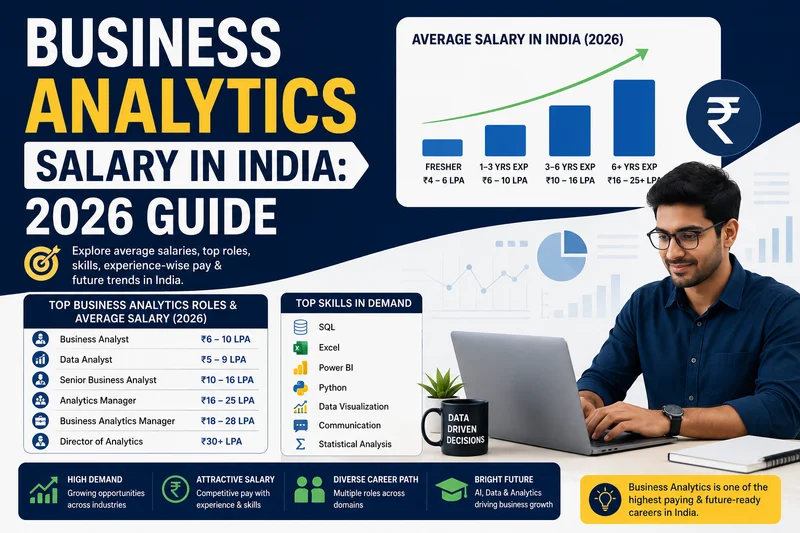
The Honest Guide to Business Analytics Salaries in India (2026)
Alright, let's cut through the noise. If you’re a student right now, you’ve probably heard everyone and their uncle talking about "Business Analytics." It’s the new hot career. But let’s be real: you don't want a lecture on how data is the "new oil." You just want to know if this career path is actually worth your time, how much money you’ll make, and what the ground reality looks like in India today.
Let’s break it down, completely unfiltered.
The Big Question: What’s the Starting Salary?
If you are just graduating college and looking for your first job as a fresher, your salary depends entirely on how much practical stuff you know.
The Reality Check: Most freshers starting out in regular IT companies or smaller firms make anywhere between ₹4.5 Lakhs to ₹6.5 Lakhs per year. That translates to roughly ₹35,000 to ₹50,000 a month landing in your bank account after taxes and PF deductions.
The High Achievers: If you are from a top-tier college, or if you’ve done a really solid, industry-focused certification program where you actually built real projects, you can push that starting package to ₹7 LPA or ₹9 LPA.
The cool thing about this field isn't where you start, though—it’s how fast it jumps.
Once you get 2 to 3 years of experience under your belt, you aren’t just a fresher cleaning up data anymore. You're solving actual business problems. At that stage, your salary easily jumps to ₹9 LPA to ₹14 LPA. And if you stick with it for 5+ years and become a senior analyst or team lead, you are looking at ₹18 Lakhs to ₹25+ Lakhs a year.
Why Does One Analyst Make More Than Another?
You’ll see some seniors getting ₹4 LPA and others getting ₹10 LPA right out of college. Why the massive gap? It comes down to three simple things:
1. What You Actually Know (Skills)
College degrees usually teach old theories. The corporate world doesn't care if you memorized a textbook. They want to know: Can you write a clean SQL query to pull data? Can you build a dashboard in Power BI or Tableau that a manager can actually understand? Do you know enough Excel to handle large files without the system crashing? If you know SQL, Excel, and a visualization tool, you are already ahead of 80% of your peers.
2. The Type of Company
Mass Recruiters / IT Services: They take a lot of people but pay a bit lower on average to start (around ₹3.5 to ₹5 LPA). Great place to get a brand name on your resume, but slower salary growth.
Product-Based Companies & Startups: Think of apps you use daily—fintech, e-commerce, food delivery. They have massive amounts of live data and need smart people to figure out why users are dropping off. They pay the best, often offering ₹8+ LPA to freshers who know their stuff.
Consulting Firms (The Big 4): They hire analysts to work directly with global clients. Pay is solid, and the learning curve is massive.
3. Where the Job Is
Geography is real. A business analyst in Bangalore or Gurgaon usually makes 15% to 20% more than someone doing the exact same job in a smaller city. Why? Because that's where the tech hubs are. Mumbai pays incredibly well too, especially if you get into data roles for banks and financial institutions.
How to Actually Land a Good Package
If you are a student looking at the job market right now, the biggest mistake you can make is just sending out a generic resume with your college GPA on it. Every single graduate is doing that.
To stand out, you need to bridge the gap between what college teaches and what companies actually want. This is exactly where specialized training places come into play. For example, institutes like Learnhub Education focus entirely on teaching you the actual tools—like SQL, Python, and Power BI—by making you work on real corporate case studies. When you go into an interview and can show a portfolio of projects you built yourself, the recruiter stops looking at your college marks and starts looking at your capability. That is how you negotiate a higher salary.
The Bottom Line
Is Business Analytics a good career choice? Absolutely. It’s one of the few fields where you don’t need to be a hardcore coder to make a fantastic tech-level salary.
Don't stress too much about the competition. Most people just talk about data; very few actually sit down to learn the tools. Focus on building your skills, get the right guidance from platforms like Learnhub Education, and by the time you graduate, you’ll be the one choosing between job offers instead of chasing them.
What tools have you started learning so far? Let me know if you want to know which one to pick first!
FAQs:
1. Do I need to be a coding genius to make good money here?
Absolutely not. If you wanted to write deep code all day, you'd try to be a software developer. Business analytics is the bridge between tech and management. You don't need Java, C++, or complex data structures. You just need to master SQL to talk to databases and Excel to sort through the files. The real paycheck comes from your logic—can you look at a sales chart, see a drop, and explain why it's happening in plain English?
2. Which city in India will pay me the absolute most?
Bangalore is the clear winner for tech and product-based packages. Because the startup and SaaS (Software as a Service) ecosystem is dense there, companies pay a premium to snatch up talent. Mumbai is a very close second, but it dominates in finance—if you want to do analytics for major banks, investment firms, or consulting giants, Mumbai offers top-tier compensation.
3. What is the actual "in-hand" salary per month for a beginner?
When a company offers you a Cost to Company (CTC) of ₹6 LPA, do not expect ₹50,000 to drop into your bank account every month. Welcome to corporate India. After cutting out Provident Fund (PF), professional tax, and the "variable pay" component (which they only give you if the company hits its quarterly targets), your actual take-home cash will be around ₹42,000 to ₹45,000 per month.
4. Is an MBA mandatory to cross the ₹15 LPA mark?
Ten years ago, maybe. Today? Absolutely not. Startups and modern tech companies care about your execution, not your degrees. If you have 3 to 4 years of proven field experience, know how to handle stakeholder meetings without flubbing, and can extract deep insights from data, you will blast past ₹15 LPA entirely on your portfolio.
5. What are the absolute "must-learn" tools if I want to get hired fast?
Stop trying to learn 15 different tools superficially. Focus heavily on these three:
SQL: 85% of your technical interviews will test you on this. You must know how to extract data.
Advanced Excel: Master pivot tables and complex lookups. Most offices still run entirely on Excel.
Power BI or Tableau: Pick one and learn how to turn ugly rows of data into clean, visual graphs.
6. Can a non-engineering student (B.Com/BBA) survive and earn well here?
They don't just survive; they often thrive. Engineers are great at the technical tools, but they often struggle to understand how business works. A commerce or management student naturally understands concepts like profit margins, supply chain bottlenecks, and customer retention. If a B.Com or BBA graduate spends a few months picking up the technical skills (SQL & Power BI), they become lethal candidates for high-paying corporate roles.
7. How big of a salary jump can I get when I switch companies?
If you stay at your first company, your annual appraisal hike might just be a standard 8% to 12%. But if you work hard, gain 2 solid years of experience, and switch to a new company, the industry standard hike is usually 30% to 50%. If you happen to possess a niche skill that a startup desperately needs, you can sometimes lock in a 70% to 100% jump.
8. Do low college percentages or GPAs kill my chances of a high salary?
Only during on-campus placements, because massive companies use GPA filters simply to reduce the crowd of thousands of applicants. Once you step out of college and apply off-campus, no one looks at your college marks. The manager interviewing you only cares about one thing: "Here is our messy company data—can you make sense of it for us?"
9. What’s the difference between Data Analyst and Business Analyst pay?
At the entry level, their salaries are quite similar (around ₹4.5 to ₹7 LPA). However, their daily work is different. A Data Analyst is more technical, spending time cleaning data and sorting code. A Business Analyst takes those clean data numbers and negotiates strategies directly with management. Because the Business Analyst is closer to the final decision-making process, their pay can scale up faster as they gain leadership skills.
10. What is the number one reason students fail their interviews?
They memorize the tools but fail at communication. Anyone can watch a YouTube tutorial and learn how to click a button to generate a chart. But if the interviewer asks you: "What does this chart mean for our operational costs?" and you freeze up or start talking in technical gibberish, you fail. Companies pay for your ability to explain complex data to people who don't understand data.