Phone: +91-9310885321
 Email: support@learnhub4u.com

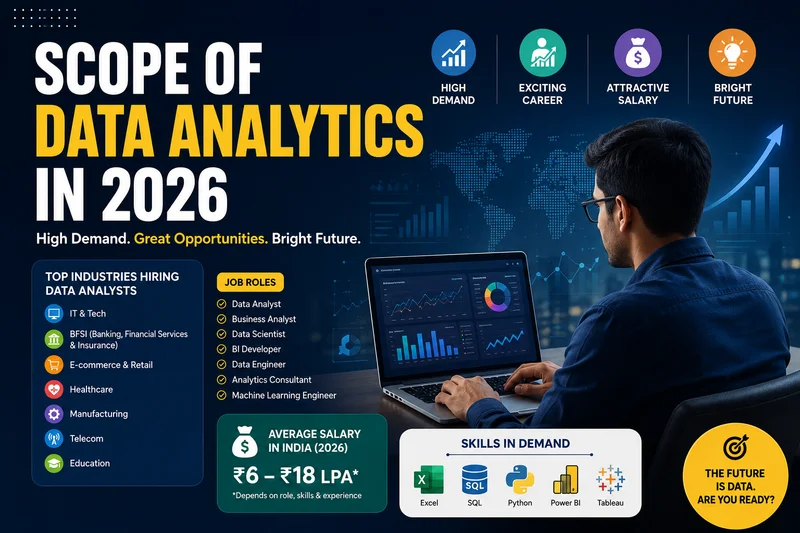
What's actually going on with data analytics this year?
Let's just be completely real for a minute. If you are looking at getting a job in data right now in 2026, it feels a bit terrifying. Every time you open your phone, someone on social media is screaming about how ChatGPT or some new AI tool just replaced five human jobs. It makes you wonder if studying this stuff is just a massive waste of time and money.
But here is the actual truth from someone looking at the market: AI didn't kill data analytics. It just killed the worst parts of the job.
Think about what a junior data analyst used to do a few years ago. You’d sit at a desk for eight hours, copy-pasting messy numbers from old databases, fixing broken commas in Excel sheets, and writing the exact same basic code over and over. It was mind-numbing. Today, AI does that grunt work in two seconds.
So what do companies actually need you for now? They need your brain, not your typing speed. An AI can look at a spreadsheet and instantly spit out a chart showing that a company lost 20% of its customers last month. But the AI doesn't know why. It doesn't know that a competitor launched a massive viral trend on TikTok, or that the company’s website crashed during a holiday sale.
You are the person who connects the dots. You take the data, figure out the human story behind it, and tell the team what to do next. As long as you can think critically, you are irreplaceable.
Where are the actual jobs right now?
Forget just trying to work at Google or Meta. Literally every single business is drowning in data right now and they have no idea what to do with it.
If you love sports, teams are hiring data nerds to look at player stats and predict injuries. If you are into fashion or online shopping, brands need people to track trends so they know what clothes to manufacture next month. Even the entertainment industry—places like Netflix or Spotify—lives and dies by analysts figuring out what songs or shows keep people hooked.
It’s way broader than it used to be. You don't have to just sit in a dark finance corporate office anymore; you can apply data to whatever you are already genuinely interested in.
The skills that actually matter (and the trap to avoid)
If you search "how to become a data analyst" online, you will find these insane, overwhelming roadmaps telling you to learn thirty different coding languages and math theories. Don't fall into that trap. It's overkill.
To get your foot in the door, you only need a few core things:
SQL and basic Python: Just enough to grab the data you need without relying on someone else.
Data Visualization: Being able to use tools like Tableau or PowerBI to turn a massive, ugly table of numbers into a simple graph that a normal human can understand at a glance.
Communication: This is the big one. If you can explain a complex chart to a marketing manager who hates math, without making their eyes glaze over, you will never be out of a job.
How do you actually stand out?
The biggest hurdle you're going to face is the classic loop: "You need experience to get a job, but you need a job to get experience."
Sitting in a classroom listening to a professor read off PowerPoint slides from five years ago isn't going to cut it anymore. Employers don't care about a piece of paper; they want to see what you can actually build. They want to see your portfolio.
This is the exact gap that places like Learnhub Education are trying to fix for students. Instead of making you memorize formulas for a written exam, they throw you straight into real-world projects. You get your hands dirty with messy, real-life datasets—solving the exact types of problems that a real company would throw at you on your first day of work. It’s all about building stuff you can actually show to a hiring manager to prove you know your stuff.
The Bottom Line
Is it still worth jumping into data analytics? Yes, absolutely. The world isn't going to suddenly start creating less data. We are creating more of it every single second.
Don't let the AI hype scare you away. Lean into the human side of the job—the curiosity, the problem-solving, and the storytelling. Find a place like Learnhub Education to get your practical foundations down, start building your own projects, and stop stressing. The field is wide open if you're willing to actually think instead of just memorize.
FAQs:
1. What tools should I actually learn first without getting overwhelmed?
Don’t try to learn twenty things at once. Start with Excel, because believe it or not, almost every business on earth still runs on it. Once you're comfortable there, learn SQL, because that’s how you actually talk to databases to get the info you need. After that, pick up Tableau or PowerBI so you can turn those numbers into simple charts that normal people can actually read.
2. What does the day-to-day work actually look like?
It’s basically detective work. A manager will come to you with a problem, like "Why are people leaving our app without buying anything?" You dig into the database, pull out the numbers, clean up all the errors, make a simple graph that explains the problem, and then sit down with the team to tell them exactly what needs to be changed to fix it.
3. What’s the real difference between Data Analytics and Data Science?
Keep it simple: a data analyst looks at the past and present to solve current problems, like figuring out why sales dropped last quarter. A data scientist is more focused on the future, using heavy coding and machine learning to predict what might happen next year. Analytics is way easier to break into when you're just starting out.
4. How do I beat the "entry-level job requires 3 years of experience" trap?
You skip the resume pile by building a portfolio. Instead of just sending a boring one-page CV, you send a link to actual work you've done. Find a messy public dataset about something you genuinely care about—like football stats, movie box office numbers, or housing prices—clean it up, build a cool dashboard, and show exactly how you analyzed it. That proves you can do the job before they even hire you.
5. Is learning from YouTube tutorials enough to get hired?
YouTube is amazing for learning how a specific button or coding function works, but it’s terrible for structured learning. It’s easy to get stuck in "tutorial hell," where you just copy what the screen does without actually understanding why. You need structured, hands-on practice to actually build problem-solving skills.
6. Which industries are hiring the most right now?
Literally every business is drowning in data, but the biggest hiring areas are E-commerce (predicting what shoppers want to buy next), Entertainment (like Netflix or Spotify figuring out what shows or music keep you hooked), Sports (analyzing player performance), and Healthcare (making hospitals run more efficiently).
7. What is the single most important soft skill to have?
Communication, 100%. You can be the greatest coder in the world, but if you can’t explain your findings to a marketing director who hates math without making their eyes glaze over, your work is useless. You have to be able to tell a simple story with the numbers.
8. Should I learn Python or R?
Go with Python. R is great for academic research and heavy university statistics, but Python is what the vast majority of the corporate and tech world actually uses. Plus, Python reads much more like standard English, so it’s way easier for beginners to pick up.
9. What is "data cleaning" and why does it take so long?
Data in the real world is incredibly ugly. People typo their names, systems double-count transactions, and important fields get left blank. Data cleaning is just the process of fixing or tossing out those errors so your final reports are actually accurate. It takes up a huge chunk of your time, but it's crucial.
10. Are certificates from online courses worth the money?
The piece of paper itself won't get you a job—no manager is going to hire you just because you have a PDF badge. What actually matters is the real skills you learned while getting it and the projects you built to pass the course. Focus on the knowledge, not the certificate.
11. Is the field getting too crowded for beginners?
It’s crowded at the very bottom with people who took a quick two-week course and only know how to make a basic pie chart. But there is still a massive shortage of analysts who actually know how to think critically, understand business goals, and talk to people like a normal human. If you focus on real, practical problem-solving, you don't have to worry about the crowd.