Phone: +91-9310885321
 Email: support@learnhub4u.com

Business Analytics vs. Data Analytics: A Plain English Guide for Students
If you are looking at tech or business majors right now, you have definitely run into these two words: Business Analytics (BA) and Data Analytics (DA). Every university brochure, bootcamp, and online course hypes them up as the ultimate ticket to a great career, but they all use the same confusing corporate fluff to describe them.
If you read the descriptions online, they sound exactly the same. You stare at spreadsheets, you look at numbers, and you get paid well.
But at Learnhub Education, we talk to students every day who are tearing their hair out trying to pick between the two. The truth is, choosing one over the other sets you up for a completely different daily routine. Let’s break down the real differences without the textbook jargon, so you can figure out what you actually want to do with your life.
The Easiest Way to Tell Them Apart
To understand the difference, forget the formal definitions for a second and just think about a company everyone knows, like Netflix.
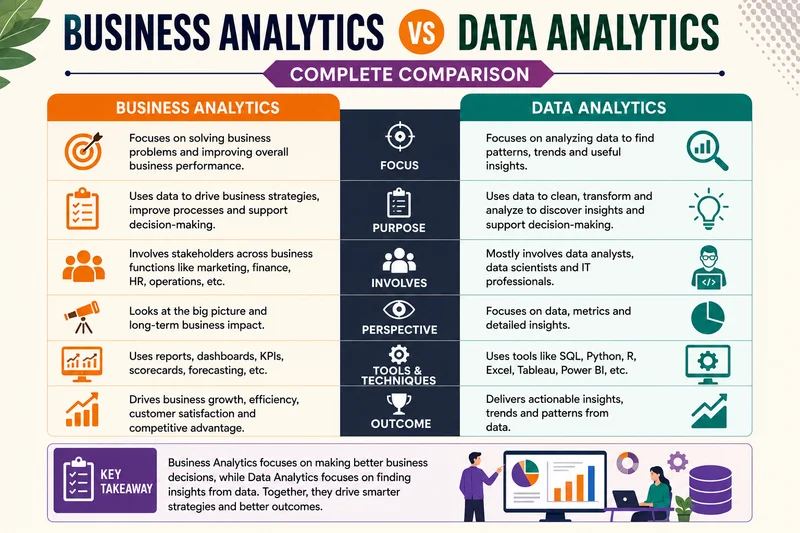
A Data Analyst is the technical detective behind the scenes. They are looking at the raw, messy database. They write code to track exactly how many seconds your mouse hovers over a movie poster before you scroll past it. They clean up corrupted system logs and build the actual tracking dashboards. They care about the data itself—getting it, cleaning it, and making sense of it.
A Business Analyst stands on top of that data and looks at the bigger picture. They take those charts and ask, "Okay, if users are skipping past comedy titles after three seconds, how do we fix our marketing? Should we change the thumbnail art to get more renewals next month?" They take the numbers and turn them into a real corporate game plan.
The shorthand rule: Data analysts find the secrets hidden deep inside the numbers. Business analysts figure out what moves the company needs to make once those secrets are out.
What Does a Data Analyst Actually Do?
If you are the kind of person who loves logic puzzles, hates guesswork, and enjoys getting lost in a computer screen for a few hours with your headphones on, Data Analytics is probably your lane.
In the real world, data isn't neat. It’s incredibly messy, full of duplicates, missing fields, and typos. A data analyst spends a massive amount of time just scrubbing this data so it’s accurate enough to use. Once it’s ready, you write code to pull specific trends and build visual dashboards.
The stuff you’ll have to learn:
SQL: The absolute baseline language used to talk to databases and pull out the data you want.
Python or R: Programming languages used to handle data sets that are way too massive for Excel to open.
Tableau or Power BI: Software used to turn massive spreadsheets into interactive, colorful charts.
What Does a Business Analyst Actually Do?
If you like data but the idea of sitting in front of a wall of code all day sounds like torture, look at Business Analytics. This field is all about communication, strategy, and problem-solving.
Business analysts are the bridge between the tech team and the bosses. Your job is to solve specific problems for a company—like why sales dropped last quarter, or how to make an app easier for older people to use. You spend way less time coding and a lot more time in meetings talking to managers, interviewing users, and building presentations to pitch your ideas.
The stuff you’ll have to learn:
Advanced Excel: You will live in this software. It’s still the king for business budgets and quick models.
PowerPoint & Visual Presentation: Because a great business strategy means nothing if you can’t explain it clearly to a room full of executives.
Project Management Tools (like Jira or Trello): Systems used to keep projects moving and make sure everyone is hitting their deadlines.
Which One Actually Fits Your Brain?
Don’t just choose a path because of a salary chart you saw on Google. Think about what you actually enjoy doing every day. At Learnhub Education, we tell students to look at their own personality:
Go with Data Analytics if: You love independent "deep work," you like math or coding, and you get a weird sense of satisfaction from fixing a broken computer problem or finding a hidden pattern.
Go with Business Analytics if: You are more of a people person, you love brainstorming strategies, you like giving presentations, and you want to understand how a business actually makes money.
The Career and Job Market Reality
The good news is that you really can’t make a wrong choice here. Companies are completely drowning in information right now, and they have no idea what to do with it. Both fields offer amazing job security and great starting pay.
If you start in Data Analytics, you’ll likely begin as a junior analyst or business intelligence specialist. As you get more experience, you can easily pivot into Data Science or Machine Learning, which are some of the most lucrative technical jobs out there today.
If you choose Business Analytics, you’ll jump into roles like Operations Analyst, Product Consultant, or Project Manager. Because you learn how a whole business runs from day one, this path is a great fast-track if your ultimate goal is to move into corporate leadership or start your own company later on.
A Quick Experiment to Help You Decide
If you are still completely torn, don't overthink it. Try a quick test this weekend:
Spend a couple of hours on Saturday watching a basic SQL tutorial on YouTube. Try writing a few simple database queries yourself.
Spend a couple of hours on Sunday looking up an old business case study (like how Apple decided to launch the iPhone) and think about how you would solve a similar problem.
See which day felt less like boring homework and more like a puzzle you actually wanted to solve. Trust your gut, pick a direction, and don't look back. You've got this!
FAQs:
1. Is Data Analytics always an office job?
Because Data Analytics is almost 100% computer-based and doesn't require you to constantly sit in client meetings, it is one of the most remote-friendly fields out there. Business Analytics can also be remote, but it generally requires a lot more video calls and face-to-face collaboration because you are constantly interviewing different teams.
2. I’m a massive introvert. Which path should I choose?
Go with Data Analytics. You get long stretches of uninterrupted "deep work" time where you can put your headphones on, look at a screen, and write queries or clean data. Business Analysts spend a huge chunk of their day running meetings, negotiating with stakeholders, and presenting ideas, which can be exhausting if you hate constant socializing.
3. Will AI replace these jobs anytime soon?
AI will replace the boring stuff, like writing basic code templates or formatting spreadsheets, but it won't replace the analyst. AI has zero human context. It doesn't understand office politics, why a specific client is angry, or the cultural nuances of a new marketing campaign. Humans are always needed to make the final executive call.
4. What is the absolute first tool I should learn?
Before you touch Python, SQL, or any flashy software, master Microsoft Excel. Don't skip it. If you don't know how to use pivot tables, XLOOKUP, and basic data filtering, you will struggle in both fields. Excel is still the undisputed king of the corporate world.
5. What's the difference between a Data Analyst and a Data Scientist?
Think of a Data Analyst as someone looking at the past and present (e.g., "Why did our sales drop last month?"). A Data Scientist looks at the future. They use heavy machine learning, advanced math, and predictive algorithms to guess what will happen next (e.g., "Which customers are most likely to cancel their subscriptions next quarter?").
6. What does "data cleaning" actually mean?
It sounds incredibly boring because it is, but it takes up 70% of a data analyst's time. Imagine a survey where people typed in their country. Some wrote "USA," some wrote "United States," some wrote "us," and some made typos like "UAS." The computer thinks those are four completely different places. Cleaning means fixing all those errors so the data is uniform.
7. Is Business Analytics just a fancy name for an MBA?
Not quite. An MBA is a very broad degree that teaches you about leadership, HR, corporate finance, and organizational behavior. Business Analytics is much more specific—it is the data-driven side of management. It teaches you how to use actual numbers and concrete evidence to make those big managerial decisions, rather than just guessing.
8. What kind of industries hire analysts?
Literally every single one. Hospitals need data analysts to track patient wait times; sports teams need them to analyze player performance; retail brands need business analysts to figure out inventory; and gaming companies need them to see how players interact with their apps. You can work in fashion, tech, music, or finance.
9. How do I build a portfolio if I have zero job experience?
Go to websites like Kaggle and download a free public dataset on something you actually care about (like video game sales, Spotify tracks, or movie stats). Clean the data, pick out three interesting trends, turn them into simple charts using Power BI or Tableau, and write a quick 300-word summary explaining what you found. Put that link right at the top of your resume!