Phone: +91-9310885321
 Email: support@learnhub4u.com

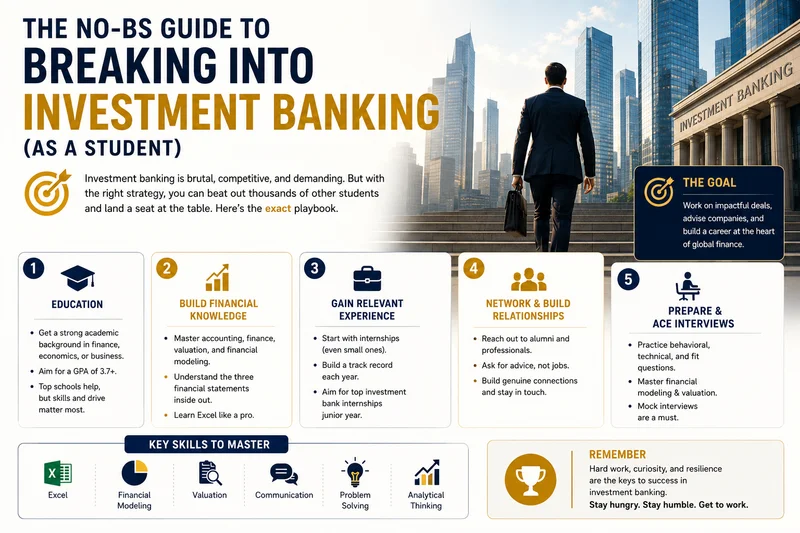
The No-BS Guide to Breaking Into Investment Banking (As a Student)
Let’s be completely honest right from the jump: investment banking is a brutal industry to crack. You’ve probably seen the glamorous side on social media—the insane paychecks, the custom suits, the high-profile deals. But what people don’t show you are the 14-hour workdays, the mind-numbing Excel sheets at 3:00 AM, and the sheer volume of rejection letters you have to swallow before you get a foot in the door.
If you are a student looking at this field, it can feel like a closed club. But it isn't impossible. It just requires a very specific strategy.
At Learnhub Education, we don’t believe in sugarcoating the process. If you want to beat out thousands of other hungry students for a seat at the table, here is the exact, unedited playbook you need to follow.
The Reality Check: What Are You Actually Signing Up For?
Before you spend your college years sacrificing your sleep and social life, you need to understand what an entry-level Analyst actually does.
You aren't going to be making major executive decisions on day one. You are the engine room. Your job is to take massive amounts of financial data and turn it into clean, flawless presentations (called "pitch books") that senior bankers use to pitch deals to CEOs.
You will spend your days:
Analyzing company balance sheets to figure out what a business is actually worth.
Building financial models to simulate mergers, acquisitions, or stock launches.
Fixing formatting errors in PowerPoint slides at midnight because a font looks slightly off.
It is exhausting, repetitive, and highly demanding. But the payoff? You learn more about corporate finance in two years than most people learn in a decade, and it opens doors to venture capital, private equity, and hedge funds that stay closed to everyone else.
Step 1: The Gatekeeper (Your GPA)
Let's clear up a major misconception: you don't strictly need a finance degree to get into banking. Banks hire history, engineering, and psychology majors every year. Why? Because they care about how smart and driven you are, not just the title on your diploma.
However, there is one thing they do care about massively, and it’s your GPA.
Because thousands of students apply for every single banking internship, HR teams use automated software to weed people out. If your GPA is below a 3.5, your resume is usually tossed into the digital trash before a human ever sees it.
If you are early in college, protect your GPA like your life depends on it. Aim for a 3.7 or higher. If your GPA is currently lower, you are going to have to work twice as hard at networking to get a human to bypass the system for you.
Step 2: Stop Using Your Mouse (The Technicals)
You cannot wing an investment banking interview. The bankers interviewing you have zero patience for fluff. They will grill you on technical finance concepts to see if you'll crack under pressure.
You need to lock yourself in a room and master three things until you can explain them to a ten-year-old:
1. The Three Financial Statements
You need to know how the Income Statement, the Balance Sheet, and the Cash Flow Statement connect. If a company buys a piece of machinery, how does that ripple through all three sheets? If depreciation goes up, what happens to cash? Memorize these connections.
2. Core Valuation
How do you calculate what a company is worth? You must master the big three: DCF (Discounted Cash Flow), Comps (comparing public companies), and Precedent Transactions (looking at what similar companies were bought for in past deals). Know the pros and cons of each.
3. Excel Shortcuts
If you watch a real investment banker work, their hand barely touches the mouse. They navigate Excel entirely with keyboard shortcuts because it’s faster. Start practicing now. Toss your mouse in a drawer for a week and force yourself to navigate your laptop using only your keyboard.
Step 3: Build a Chain of Internships
Nobody wakes up junior year and lands a summer internship at a major investment bank out of nowhere. You have to build a track record that proves you can handle the corporate grind. Think of it like stepping stones:
Freshman Year: Just get something business-related on your resume. Work for a local startup, a small accounting firm, or a local wealth management office. Show that you can show up to work on time and handle data.
Sophomore Year: Step it up. Look for a boutique (small, local) investment bank, a private equity firm, or a corporate finance internship at a recognizable company.
Junior Year: This is the main event. This is the summer internship that usually converts into a permanent, high-paying job after graduation.
Warning: The recruiting timeline is insanely early. Banks start interviewing sophomores for their junior summer internships nearly a year and a half in advance. If you wait until junior year to start applying, you’ve already missed the boat.
Step 4: Cold Emails and the 15-Minute Chat
If you just drop your resume on a company website and hope for the best, you are relying on pure luck. To actually get an interview, you need an insider to pull your resume out of the pile. This is where networking comes in.
Go to LinkedIn. Search for alumni from your university who are currently working as analysts or associates at investment banks.
Send them a short, genuine message. Do not ask them for a job—that looks desperate. Instead, ask for advice.
"Hey [Name], I’m a student at [University] trying to figure out the banking path. I saw your background and would love to know how you managed the transition. Do you have 15 minutes for a quick phone call sometime this week?"
When they get on the phone, ask smart questions. Ask what their worst day on the job was. Ask what skills they wish they learned in college. If you sound humble, sharp, and genuinely hungry, that banker will likely say, "Hey, send me your resume, I’ll pass it along to our hiring team."
Step 5: The "Why Banking?" Trap
If you make it to the final round of interviews (often called a "Superday," where you face 4 to 5 back-to-back interviews in one day), you will be asked: "Why do you want to do investment banking?"
If your answer is "I want to make a lot of money" or "It looks prestigious," you fail instantly. Everyone knows the money is great. They want to hear that you are prepared for the grind.
Your answer should sound more like this: “I want to be in an environment where the learning curve is as steep as possible. I want to work on complex, real-world transactions, and I want to surround myself with people who push me to work harder than I ever thought I could.”
The Bottom Line
Breaking into this industry isn't about being a genius. It’s about discipline. It’s about maintaining a high GPA, studying technical guides when your friends are out partying, and sending fifty cold LinkedIn messages just to get two phone calls back.
It’s an uphill battle, but it is entirely doable if you start early and stay relentless. We see students make this leap every single year at Learnhub Education—not because they got lucky, but because they put in the boring, unglamorous work when nobody was watching. Clean up your resume, start reaching out to alumni, and get after it.
FAQs:
1. Can I break into investment banking from a non-target state school?
Yes, but you have to work twice as hard as an Ivy League student. Bulge bracket banks (like Goldman Sachs or JP Morgan) don't actively recruit on your campus, so your online applications will likely hit a wall. You have to rely 100% on cold-emailing alumni, building relationships, and forcing your way into the interview room through referrals.
2. Is a 3.4 GPA completely dead for banking?
It’s not totally dead, but it makes things incredibly tough for large banks because of their automatic HR filters. If you are below a 3.5, you should shift your focus to boutique (smaller, local) investment banks or middle-market firms. They are much more flexible with GPA requirements if you can prove you know your technical finance concepts inside and out.
3. What actually happens if I use my mouse during a banking interview?
They won’t watch you use a mouse in a standard interview, but some firms will give you an Excel modeling test. If they see you clicking through menus to do a simple formula instead of using keyboard shortcuts, it shows you haven't put in the hours. It signals that you're slow, and in banking, time is literally money.
4. Do I really have to start networking in my freshman year?
You don't need to go crazy sending cold emails as a freshman, but you do need to start building a foundation. Use your freshman year to get any business internship and keep your GPA near perfect. The real, aggressive networking push should start at the beginning of your sophomore year, because junior year internship recruiting happens insanely fast.
5. Why do investment bankers work 80+ hours a week if the work is just Excel and slides?
Because of client demands and unpredictable timelines. A CEO might suddenly demand a complete valuation change at 6:00 PM for a meeting the next morning. Because senior bankers want to secure the multi-million dollar deal, the work gets pushed down to the analyst, who has to stay up all night rebuilding the model from scratch to make sure it's perfect.
6. Can I break in if I major in something like History or Psychology?
Absolutely. Banks actually like a bit of diversity because they get tired of reading identical resumes from finance majors. The catch is that you still have to pass the exact same technical interview. You have to prove on your resume—through finance clubs, case competitions, or online courses—that you taught yourself accounting and corporate finance on the side.
7. What exactly is a "Superday"?
It’s the final stage of the interview process. If you pass the initial phone screens, the bank flies you out (or brings you onto a massive Zoom schedule) for 4 to 5 back-to-back interviews in a single morning or afternoon. You will face a mix of vice presidents, directors, and managing directors who will grill you on technicals, test your personality, and try to see if you crack under pressure.
8. How long should my resume be?
Exactly one page. No exceptions. If you are a college student and your resume stretches onto a second page, it shows you don't know how to edit or summarize information. Keep your bullet points punchy, impact-oriented, and focused on numbers (e.g., "Analyzed financial statements for 5 target companies," not "Responsible for looking at data").
9. Is investment banking really as toxic as people say online?
It depends entirely on the specific group and the culture of the senior managers you work for. Some teams are incredibly supportive and look out for their juniors; others treat analysts like disposable machines. The hours are universally brutal across the board, but the "toxicity" varies heavily from office to office.
10. What are "Exit Opportunities" and why does everyone talk about them?
Most people don't stay in investment banking forever because the lifestyle is unsustainable. "Exit opportunities" are the highly lucrative careers you can pivot into after doing your two-year analyst stint. Private Equity (PE), Venture Capital (VC), and Hedge Funds almost exclusively hire straight out of investment banking programs because they know banking analysts have been properly trained.