Phone: +91-9310885321
 Email: support@learnhub4u.com

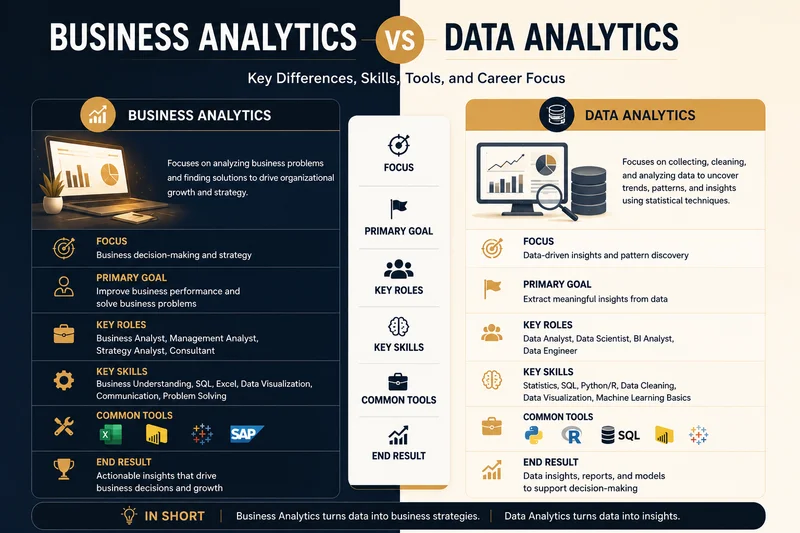
Let's Talk Career Paths: Business Analytics vs. Data Analytics
If you are trying to figure out your next step in college or planning a career shift, you have probably run into two terms constantly: Data Analytics and Business Analytics. On paper, they sound like the exact same thing. Both deal with numbers, both require a computer, and both are massive industries right now.
But if you talk to anyone actually working in these fields, you’ll find out quickly that they are completely different career paths. Choosing the wrong one can mean sitting in front of code all day when you actually wanted to work with people, or vice versa.
At Learnhub Education, we talk to students every day who are confused by the technical jargon. Let's break down what these roles look like in the real world so you can figure out where you fit.
The Core Difference: Numbers vs. Strategy
The easiest way to understand the divide is to look at what each role is trying to accomplish.
Data Analytics is all about the technical architecture of information. A data analyst focuses heavily on the raw numbers themselves. They clean messy datasets, look for trends, and build the infrastructure needed to make sense of information. They look backward and inward to tell a company exactly what happened.
Business Analytics is about the practical application of those numbers. A business analyst takes the trends discovered by the data team and turns them into a business plan. They focus on the big picture, looking forward to answer the question: What should our company do next to grow or run better?
Let’s use a real-world example you probably use every day: Zomato or Swiggy.
A Data Analyst is the person looking at millions of rows of user data to find a hidden pattern—like noticing that orders for iced coffee spike by 40% when the temperature hits exactly 34°C. They write the scripts to pull that information and format it clearly.
A Business Analyst takes that specific insight and turns it into a business strategy. They say, "Okay, since iced coffee spikes at 34°C, let's build an automatic push notification system that sends a discount coupon to users right when the afternoon heat peaks. This will boost our afternoon revenue by 15%."
A Day in the Life of a Data Analyst
If you choose Data Analytics, you are choosing a highly technical path. You will spend a lot of time working independently or with other engineers, playing the role of a data detective.
When a company collects data, it is usually incredibly messy. It contains errors, missing information, and duplicate entries. A data analyst's primary job is to write code to clean this data up so it can actually be trusted.
The Toolkit You'll Use
To survive in this role, you have to get comfortable with the technical side of things:
SQL: This is non-negotiable. You use SQL to talk to databases and pull out the specific information you need.
Python or R: You will use these programming languages to automate tasks, clean data, and run statistical models.
Data Visualization Tools: Software like Tableau or Power BI allows you to turn millions of rows of data into a clean, visual dashboard that a regular manager can read.
If your idea of a good day is solving a complex logic puzzle, writing clean code, and working quietly without constant meetings, this is your domain.
A Day in the Life of a Business Analyst
Business Analytics is much closer to corporate strategy and management. If you enter this field, you aren't going to be buried under heavy code all day. Instead, you'll be spending a huge chunk of your time talking to people.
Business analysts act as a bridge. Tech teams and business executives speak completely different languages. Executives care about profit margins, market share, and cutting costs. Developers care about server uptime, codebase efficiency, and APIs. The business analyst stands right in the middle, translating technical realities into corporate strategy.
The Skills That Matter
Because this role is so focused on implementation, your soft skills matter just as much as your hard skills:
Business Sense: You need to understand how a company actually functions—how marketing feeds into sales, how supply chains work, and how budgets are managed.
Communication: You have to present your findings to senior directors who might not know anything about coding. Your job is to make data simple and persuasive.
Advanced Excel: While you might pull data using basic SQL, you will spend a ton of time modeling different business scenarios inside Excel.
If you like the idea of using data to influence major company decisions, presenting ideas to leadership, and collaborating across different departments, you belong here.
How to Choose: The Honest Checklist
It can be tough to look at yourself objectively and pick a path. To make it easier, ask yourself these direct questions:
Do you want to build things, or do you want to change things?
Data analysts love the process of building systems, writing scripts, and finding absolute truths in numbers. Business analysts care less about how the data was gathered and more about how they can use it to fix a broken business process.
What is your relationship with coding?
If you genuinely enjoy programming, or if you are coming from a Computer Science or engineering background, Data Analytics is a natural extension of your skills. If the idea of writing code for six hours a day sounds exhausting, but you still love statistics and strategy, look closely at Business Analytics.
Where do you want your career to go?
Data analysts often progress into advanced technical roles like Data Science, Machine Learning Engineering, or Data Architecture. Business analysts tend to climb the management ladder, moving into roles like Product Manager, Operations Director, or even Chief Operating Officer (COO).
Getting Your Foot in the Door
The good news is that the corporate world is completely overwhelmed by data right now, and there is a massive shortage of people who actually know how to handle it. Companies are hiring heavily across both sides of the aisle.
At Learnhub Education, we focus on preparing you for the realities of the actual job market, not just teaching you textbook theories. Whichever path clicks with your personality, the key is to start building a portfolio of practical projects. Don't just read about SQL or business strategy—open up a dataset, find an interesting problem, and try to solve it.
Take a look at your own strengths. Are you the coder or the strategist? Once you know that answer, your career path becomes incredibly clear.
FAQs:
1. Which career path pays better right out of college?
They are pretty much equal at the start, but for different reasons. Data analytics might give you a slightly higher starting salary just because coding is a specialized skill that not everyone can do. But business analysts usually climb up the management ladder a lot faster, and that’s where the really massive corporate money is later on.
2. Can I start as a Data Analyst and switch to Business Analytics later?
Yes, and honestly, this is one of the smartest ways to do it. It is always easier to teach a technical person how a business works than it is to teach a business person how to code. If you already know how to handle the data, moving into a strategy role is a natural next step.
3. What if I want to go from Business Analytics to Data Analytics?
You can do it, but you'll have to put in some serious study hours. You can't just wing the technical side. You will have to sit down, learn how programming languages function, master database structures, and get comfortable with heavy statistics. It’s a steep learning curve if you don't like tech.
4. What is the number one tool I need to learn for Business Analytics?
Everyone talks about fancy software, but Advanced Excel is still what actually runs the corporate world. If you can build a solid financial model, organize a messy sheet, and use basic formulas without panicking, you are already ahead of half the applicants out there.
5. What tool is a must-have for Data Analytics?
SQL. No debate here. Before you can analyze any data, you have to find it and pull it out of a massive company database. If you don't know how to write a SQL query to fetch information, you literally cannot do the job. Python comes right after that, but start with SQL.
6. Is AI going to take over these jobs anytime soon?
AI can write basic code blocks or clean up typos in a sheet, sure. But ChatGPT can't sit in a stressful board meeting, handle difficult bosses, or understand why a specific marketing strategy fits a company's vibe. The human side of making actual decisions based on real-world context isn't going away.
7. What is the actual difference between an Analyst and a Data Scientist?
An analyst looks at what already happened to solve a current problem—like figuring out why sales dropped last month. A data scientist is much more advanced. They use heavy math and machine learning to build automated systems that try to predict what will happen months from now.
8. Can I work from home in these roles?
Data analysts have a much easier time finding fully remote work because they spend most of their day doing independent deep-focus work behind a screen. Business analysts usually have to do hybrid work because their job involves constantly talking to managers, clients, and different teams.
9. I’m doing an MBA. Which side should I choose?
Stick with Business Analytics. You are already spending a ton of money and time learning how companies manage budgets, market products, and run operations. Business analytics lets you apply all of that knowledge directly, using data to prove your points instead of just guessing.
10. What do people actually mean when they say "cleaning data"?
Real-world data is a total mess. When people type things into apps, they make typos, leave fields totally blank, enter fake emails, or click buttons twice. Cleaning data just means writing a script to scrub out all that garbage so the final numbers are actually accurate before you show them to anyone.
11. Is Business Analytics just a fancy word for managing projects?
Not really. A project manager just keeps track of deadlines, calendars, and budgets to make sure a task gets finished on time. A business analyst figures out if the project is even worth doing in the first place, and how to change the plan so the company makes a higher profit.
12. What kind of companies hire for this?
Every single industry you can think of. It’s not just tech companies like Google or Zomato. Banks need analysts to spot fraud, hospital chains need them to track patient data, clothing brands need them to figure out inventory, and sports teams use them to buy the right players