Phone: +91-9310885321
 Email: support@learnhub4u.com

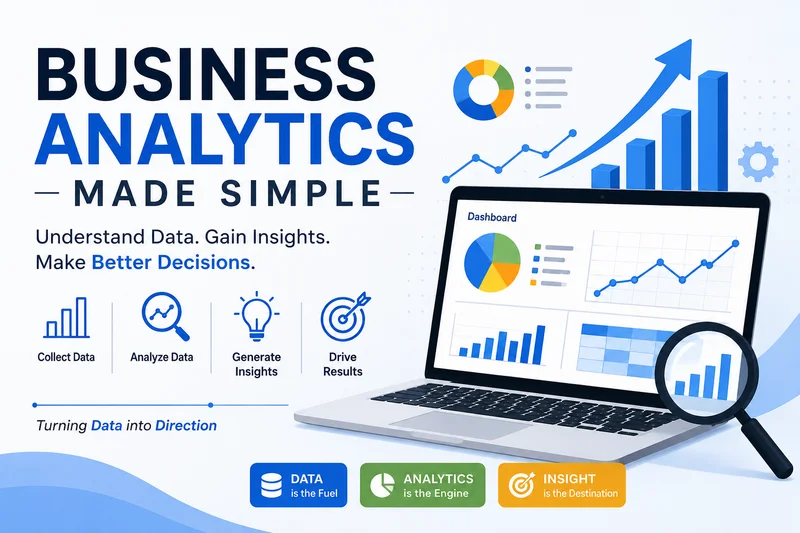
Business Analytics Made Simple
Okay so, first year of college, someone in my class asked what "business analytics" even means, and the professor gave this long answer full of words like "data-driven insights" and "predictive modeling." Half the class just nodded along pretending to get it. I was one of them. I had zero clue what was going on.
Took me a while to realize the actual idea is really simple. It's just using information you already have to make a better decision instead of guessing. That's it. Everything else people say about it is just extra decoration on top of that one basic idea.
At Learnhub Education we deal with this a lot, students getting scared off a subject just because of how it's taught, not because it's actually hard. So here's my attempt at explaining it the normal way, like I'd explain it to a friend, not a class.
What it actually means
Every business collects tons of information without you even noticing. How many people visited their website today, what people bought, what they didn't buy, how long a delivery took, which customers stopped coming back. Analytics is just looking at all of that mess and figuring out what story it's telling.
You already do a version of this yourself all the time. Say you're picking a restaurant to order from tonight. You check the rating, maybe skim a review, see how many orders it's had. You're not choosing randomly, you're using small pieces of info to decide. Businesses do this same thing, just at a much bigger scale, with actual money on the line.
I used to think this whole field was only for math people. It's really not. Sure there's some math involved eventually, but honestly the bigger skill is just being curious and asking the right question. The formulas you can pick up along the way.
The three types nobody actually explains well
There are three words that show up in literally every course. Descriptive, predictive, prescriptive. Sounds intimidating written like that, but it's not.
Descriptive is just what already happened. A shop owner checking last month's sales to see what sold best, that's descriptive analytics. Nothing fancy, just a summary of the past.
Predictive is what might happen next. If a store notices umbrella sales go up every year right before the rainy season starts, they'll order extra stock ahead of time because they're expecting the pattern to repeat. That's predictive.
Prescriptive is the "so now what" part. Once you know what happened and what's probably coming next, this is where you decide what to actually do about it. Maybe that means increasing production, or changing the price, or focusing more on one city over another.
Once it's laid out like that it stops sounding like three random terms you have to memorize. It's really just one flow. Past, future, action.
Why it matters even if you hate numbers
A lot of students skip this subject in their head before even trying because they assume it's only for people who love coding or heavy math. I thought the same thing for a while. Then I realized the actual valuable part isn't calculating anything, it's interpreting it.
Anyone can look at a chart. Not everyone can look at that same chart and say something like, customers aren't leaving because our price is too high, they're leaving because the website is slow, so fix that first before spending more on ads. That kind of thinking is what actually matters, and it has almost nothing to do with being good at math.
That's basically the whole teaching philosophy behind Learnhub Education honestly. Understand why something matters first, the technical stuff comes way easier after that.
A quick example
Say a small clothing brand notices sales dropping for a couple months straight. Without looking at any data, the instinct is usually just, spend more on ads and hope it fixes itself. But if they actually check the numbers, maybe they find out website visits are exactly the same as before. People are still showing up. They're just leaving right before completing their order.
Turns out the problem was never "not enough customers." It was a slow or broken checkout page. Completely different fix than what they were about to do, and they'd have never known without actually checking the data instead of guessing.
Getting started without losing your mind
If you're actually trying to learn this properly, don't try to learn everything at once, that's the fastest way to give up. Start with basic Excel. Get comfortable with simple charts and formulas first. Move to stuff like Power BI or SQL later once the basics feel normal. Tools change every couple years anyway, the way of thinking behind it stays pretty much the same.
Also, practice on stuff you actually care about instead of some random textbook dataset you'll forget in a week. Track your own spending for a month. Look at a sports team's stats. Check how a page you follow on Instagram is growing. Makes it feel less like homework and more like you're solving something.
Final thoughts
Business analytics isn't about turning into someone who only thinks in spreadsheets. It's about learning to read the story hiding inside the numbers and using that to make a better call. Once you stop treating it like some intimidating subject full of big words and start treating it like a normal, useful skill, it gets a lot less scary.
That's genuinely what we try to do at Learnhub Education, not just get students through an exam, but actually get them to understand something they'll use later no matter what field they end up in.
So next time this topic comes up and feels like too much, just remember, it's really just data, a bit of common sense, and being curious enough to ask why. That's basically the whole thing.
FAQs:
1. What even is business analytics?
Honestly it's just using the numbers a company already has lying around to make a smarter decision instead of guessing and hoping for the best. People make it sound way more complicated than that.
2. Do you need to be a math person for this?
Nah. I used to think so too. Turns out the actual hard part is figuring out what question to ask in the first place, the math is more like a tool you pick up along the way, not the main thing.
3. Business analytics vs data science, what's actually different?
Data science gets way more into coding and building models and heavy stats. Business analytics stays closer to real, everyday business problems, less code, more "okay so what do we do with this."
4. Everyone keeps saying descriptive, predictive, prescriptive, what does that even mean?
Descriptive is just what already happened, like looking at last month's numbers. Predictive is guessing what's coming next based on patterns. Prescriptive is deciding what to actually do about it. Once you say it like that it's not that deep.
5. What tool should I even start with as a beginner?
Excel. I know, sounds boring, everyone wants to jump straight to fancy tools, but Excel teaches you the actual thinking. Power BI and SQL make way more sense once that's solid.
6. Is this only a big company thing?
Not really, even small shops kind of do it without calling it that. Checking which item sold the most last week is technically analytics, just nobody labels it that way.
7. How long till this actually clicks?
Basics, maybe a few weeks if you're actually putting in time. Getting genuinely comfortable, like working with real messy data, that takes a few months honestly, not gonna lie.
8. I'm not from a business background, can I still learn this?
Yeah for sure. A lot of people doing this now came from totally different fields. What actually matters more is being curious and not freezing up around numbers.
9. What jobs actually use this stuff?
Business analyst obviously, but also marketing, operations, product, even finance and HR roles use it now. It's kind of everywhere at this point.
10. Why do companies obsess over this so much?
Because guessing wrong costs real money. If you're deciding based on actual numbers instead of a gut feeling, you're way less likely to waste a budget on something that flops.
11. Got a simple example of this happening in real life?
Think about how Netflix or Spotify recommend stuff based on what you already watched or listened to. That's this, happening quietly in the background.
12. Do I need coding to get into this?
Not at first, no. Basic spreadsheet skills get you pretty far already. SQL or Python type stuff comes in handy later if you want to go deeper into it.