Phone: +91-9310885321
 Email: support@learnhub4u.com

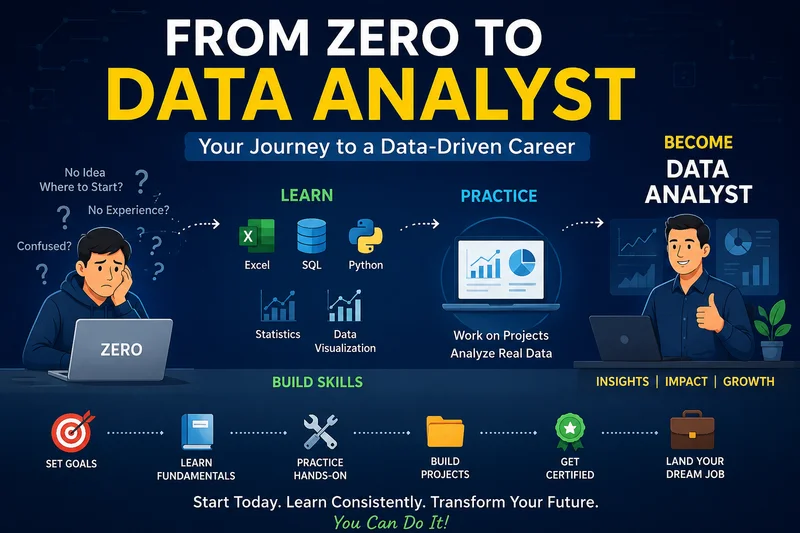
From Zero to Data Analyst: The Honest, No-BS Guide
Let’s be real for a minute. If you search "how to become a data analyst" right now, you’re going to get hit with a wall of overwhelming noise. You will see people on TikTok or LinkedIn telling you that you need a master's degree in math, or that you have to memorize three different programming languages before you can even apply for an internship.
I am here to tell you that they are overcomplicating it to sell you expensive bootcamps.
A few years ago, I didn't know the difference between a SQL query and a basic spreadsheet. I used to stare at job descriptions thinking I just wasn't cut out for tech. But I made the pivot, and at Learnhub Education, we see regular students do it every single day. You don't need to be a math prodigy. You just need a concrete, step-by-step plan.
Here is the actual roadmap to go from absolute scratch to your first job, without the fluff.
Phase 1: Don't Skip the Boring Stuff (Excel)
Everyone wants to skip straight to Python because it sounds cool. Don't do that. If you walk into a data interview and you can’t navigate a spreadsheet, you're going to get rejected immediately.
Excel is still the absolute backbone of global business. You don't need to learn every single niche feature, but you must master the core essentials:
XLOOKUP and VLOOKUP: How to pull data from one sheet into another without breaking everything.
Pivot Tables: How to take 20,000 rows of chaotic data and summarize it in three clicks.
Logical Formulas: Getting comfortable with SUMIF, COUNTIF, and basic IF/THEN statements.
The best way to learn: Stop looking at fake practice data. Download your own bank statements, your Spotify streaming history, or your favorite sports team's stats. Try to find patterns. Why did you spend so much money in October? That natural curiosity is the actual core of data analysis.
Phase 2: Talk directly to the Database (SQL)
Once a company gets too big, their data can't fit into an Excel sheet anymore. It lives in a database. To get it out, you have to talk to that database using SQL (Structured Query Language).
If Excel is your foundation, SQL is your daily bread and butter. You will use it every single day on the job. The good news is that it reads almost exactly like broken English. You are literally just telling the computer: "Hey, SELECT the customer names FROM the user table WHERE they spent more than fifty bucks."
When you start studying, focus entirely on these fundamentals:
Filtering down your data using SELECT and WHERE.
Grouping things together using GROUP BY to find averages or totals.
Stitching different tables together using JOINs. (This is usually the part where beginners get a headache, but it’s just like connecting puzzle pieces using a shared ID).
Spend most of your study time here. An analyst who is incredibly fast and accurate with SQL will always find work.
Phase 3: Make it Visual (Tableau or Power BI)
Nobody in corporate management wants to stare at a giant grid of raw numbers. Your managers, marketing teams, and executives don't have the time or patience for that. Your job is to take those numbers and turn them into a visual story that makes sense in five seconds.
Pick one tool: either Tableau or Power BI. Do not try to learn both at the same time. They do the exact same thing, just with different buttons.
Focus on building clean, simple bar charts and line graphs. The biggest rookie mistake is trying to make your dashboard look like a sci-fi spaceship control panel. If it’s too cluttered, it’s useless. Keep it simple, clean, and easy to read.
Phase 4: The Truth About Python
Here is a major insider secret: A ton of entry-level data analyst jobs don’t actually require you to code.
If you are starting from zero, put Python on the back burner for now. Master Excel, SQL, and a visualization tool first. Once you can build a project with those three, then you can start playing around with Python libraries like Pandas. But do not let the fear of coding stop you from starting today. You can get hired without it.
Phase 5: The "No-Experience" Portfolio Strategy
Everyone runs into the same frustrating trap: You need experience to get a job, but you need a job to get experience. The only way to beat this system is to build projects that prove you can do the work.
Please, do not build the same generic projects that everyone else copies off YouTube. Hiring managers can spot a copied tutorial from a mile away.
Instead, pick something you genuinely care about—whether it’s gaming trends, housing prices in your city, or fitness data. Clean the messy data up, write some SQL queries to find three interesting facts, build a quick dashboard, and write a three-paragraph summary of what the data actually means for a business.
Put that link right at the top of your resume. It changes the conversation from "Do you have experience?" to "Look at this work I just did."
The Reality Check
Let's be totally honest about the mental side of this. Learning this stuff alone at your desk is going to be incredibly frustrating at times.
You will write a query, it will throw a giant red error message, and you'll spend an hour losing your mind over a missing comma. This happens to everyone. Even senior developers and analysts still Google basic syntax errors every day. The job isn’t about being a genius who remembers everything; it’s just about sticking with a problem until you solve it.
When you feel completely stuck, take a break, step away from the screen, or lean on a community like Learnhub Education to get unstuck. Don't worry about learning everything overnight. Just focus on being slightly better today than you were yesterday. Pick up a basic SQL tutorial and just start.
FAQs:
1. Do I really need to be good at math?
No, you don't. You need basic school math like percentages and averages. The software does all the actual calculating. If you can logicalize a basic problem—like figuring out why sales dropped last Tuesday—you have enough math skills.
2. Can I get a job without a college degree?
Yes, but it’s a grind. HR software automatically blocks resumes without degrees. To bypass that, you have to network on LinkedIn and show off projects that are so good they can't ignore you. It takes more work, but it happens every day.
3. Which one should I learn: Power BI or Tableau?
Just flip a coin and pick one. They do the exact same thing. Power BI feels a bit like Excel; Tableau feels more like a design tool. Spend a day with both, see which one frustrates you less, and stick with it. Don't waste time trying to learn both.
4. How long does it actually take to learn this stuff?
It takes about 4 to 6 months if you study an hour or two every day. Anyone telling you that you can do it in a few weeks is just trying to sell you a course. The first two months are usually just getting over the confusion of how the tools work.
5. Why do all my SQL queries keep failing?
Because that’s what coding is. Get used to it now, because even senior analysts deal with this every day. Most of the time, you just missed a comma or misspelled a word. It doesn't mean you're dumb; it just means you need to check your spelling.
6. What should I do when I get completely stuck?
Walk away from your computer. Go grab a snack or take a walk. Staring at an error message for three hours straight just blinds you. Usually, the mistake is obvious the second you sit back down with fresh eyes. You can also drop your question in the Learnhub Education community to get a second pair of eyes on it.
7. What's the biggest mistake people make with portfolios?
Copying the same projects everyone else does. If your portfolio has the Titanic dataset on it, managers will know you just copied a YouTube tutorial. Pick something weird that you actually like—like your own fitness data or gaming stats.
8. What does the day-to-day job actually look like?
Most of your day is spent cleaning up messy, broken data and arguing with databases. The actual fun part—making charts and finding cool insights—is only about a quarter of the job. It’s mostly digital detective work.
9. Is the market too crowded for beginners right now?
It’s crowded with people who took a three-hour course and expect a job. If you actually build unique projects and learn how to explain your work clearly, you will stand out because most applicants don't do that.