Phone: +91-9310885321
 Email: support@learnhub4u.com

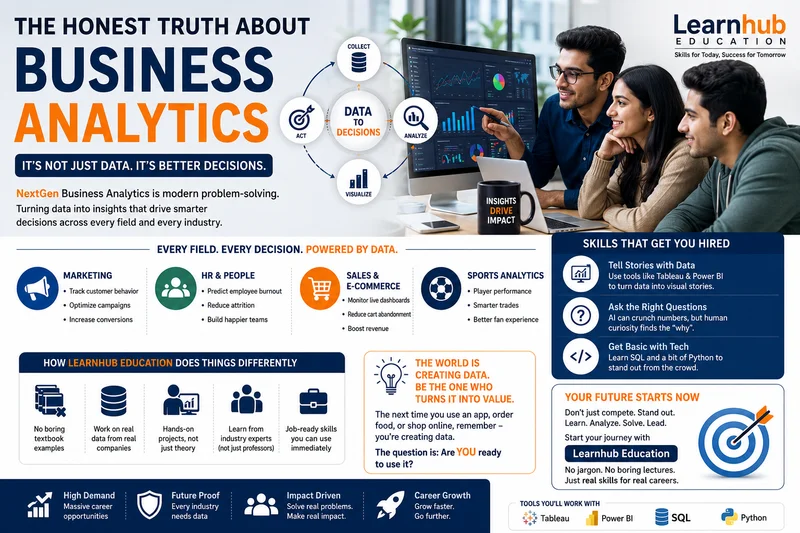
The Honest Truth About Business Analytics
If you are sitting in a college lecture hall right now, you’ve probably heard the phrase "data-driven" about a million times. Professors love it. Textbooks abuse it. But nobody ever really explains what it means for you and your actual career.
Most students think business analytics means sitting in a cubicle, staring at a massive Excel sheet with 50,000 rows of numbers, and doing high-level math until your brain fries.
It’s not that at all.
NextGen Business Analytics is basically just modern problem-solving. It’s taking the massive trail of digital crumbs that everyone leaves behind online and using it to make smart guesses about what people will do next.
Think about it this way: when you scroll on TikTok or Instagram, you aren't just looking at videos. You are creating data. Every second you hover over a post, every share, every mute—it’s all tracked. The "NextGen" part of analytics is just the technology that takes that massive pile of messy behavior and turns it into a decision, like instantly changing your feed to keep you watching.
At Learnhub Education, we talk to students every day who are terrified of this stuff because they think they aren't "math people." But the secret of the industry right now is that the computers do the heavy math. What companies actually need are humans who can look at the results and say, "Okay, here is what this actually means for our business."
Why This Isn't Just for Tech Nerds
There is a huge misconception that if you’re studying marketing, management, or HR, you don’t need to worry about data.
That might have been true ten years ago, but today, every single job is a data job.
If you want to go into marketing: You aren't just brainstorming pretty billboards anymore. You are looking at live dashboards to see exactly where people are clicking on a website and why they are abandoning their shopping carts at the last second.
If you want to go into HR: Companies literally use analytics to figure out employee burnout. They look at data patterns to see who is likely to quit next month so they can step in and fix the problem beforehand.
If you love sports: Look at how teams are run now. Everything from player trades to what food they sell at the stadium is decided by analysts looking at data trends.
If you graduate with just a basic degree, you are competing with thousands of other students who have the exact same resume. But if you can walk into an interview and show that you actually know how to read data and solve real problems with it, you instantly jump to the front of the line.
The Skills That Actually Get You Hired
You don't need a computer science degree to get good at this. You just need to get comfortable with a few specific things:
Stop looking at numbers, start telling stories. Nobody—especially not a CEO—wants to look at a raw database. They want to look at a clean graph that shows them exactly what the problem is in five seconds. Learning tools like Tableau or Power BI is basically learning how to turn ugly data into a visual story.
Learn how to ask the right questions. An AI can crunch numbers at lightning speed, but it doesn't have common sense. It doesn't know why sales dropped in July. Was it a glitch on the app? Was it a massive heatwave? You need the human curiosity to dig into the "why."
Get basic with the tech. You don't need to learn how to build software. But learning basic SQL (which is just the language used to talk to databases) and a tiny bit of Python will make you look like a wizard to 90% of employers.
How Learnhub Education Does Things Differently
The biggest problem with learning analytics in a university setting is that it’s usually incredibly boring. You spend weeks memorizing definitions, learning formulas by hand, and taking multiple-choice tests that have nothing to do with the real world.
We hate that approach.
At Learnhub Education, we build our programs to be exactly like a real job. We don't give you clean, perfect textbook examples because real-world data is incredibly messy.
Instead, we throw you straight into real project scenarios. You get to play with actual data from real companies, figure out what’s broken, and use modern tools to fix it. Our mentors aren't career academics who haven't worked in an office since the 90s—they are people who are literally doing this work right now at top companies.
What Should You Do Next?
The world isn't going to suddenly start producing less data. It’s only getting bigger, faster, and more complex. Companies are desperate for people who can bridge the gap between the technology and the human side of business.
You don't have to change your entire major or master everything by next week. Just start by changing how you look at things. The next time you use an app, order food, or buy something online, ask yourself: What data did I just create, and how is that company going to use it?
If you want to learn how to actually use this stuff to set up your career, come check out what we are doing at Learnhub Education. No corporate jargon, no boring lectures—just the actual skills you need to get hired.
FAQs:
1. I’m completely awful at math. Can I actually do business analytics?
Honestly, yes. The whole secret right now is that computers do all the heavy lifting and actual math anyway. Companies don't want human calculators; they just want someone who can look at the final charts and go, "Okay, here's what this actually means for our business." If you have common sense and curiosity, you're totally fine.
2. Is it just sitting in a tiny cubicle staring at Excel until your brain melts?
No, that’s just the old stereotype. It’s basically just modern problem-solving. Think about how TikTok tracks every single second you hover over a video just to change your feed and keep you watching—that's data behavior. It's way more interesting than staring at a 50,000-row spreadsheet.
3. I’m a marketing major, why should I care about data?
Because marketing isn't just coming up with cool billboard ideas anymore. Today, every single job is a data job. You’ll be looking at live dashboards to see exactly where people are clicking on a website, or trying to figure out why customers keep dumping their shopping carts at the very last second.
4. Will having these skills actually help me pass a job interview?
Yes, instantly. If you graduate with just a basic degree, your resume looks exactly like thousands of other students. But if you can walk into an interview and show that you know how to read data to solve real business problems, you jump right to the front of the line.
5. What tech tools do I actually need to learn to look good to employers?
Just focus on the basics to start. Learn Tableau or Power BI so you can turn ugly data into a clean graph that makes sense in five seconds. Then learn basic SQL, which is just the language used to pull info out of databases. A tiny bit of Python helps too—it makes you look like a total wizard to managers.
6. If AI can crunch numbers instantly, why do companies even need humans?
Because AI has zero common sense. An AI can tell you that sales dropped like crazy in July, but it can't tell you why. It doesn't know if there was a glitch on the app or if a massive heatwave kept everyone inside. You need human curiosity to dig into the actual reason.
7. Wait, how does data have anything to do with HR?
It sounds weird, but companies literally use it to spot employee burnout. They look at data patterns to guess who is likely to quit next month so managers can step in and fix the issues before they walk out the door.
8. I love sports but I'm not a pro athlete. Can I do something with data there?
Oh, definitely. Sports teams are completely run by data now. Everything from deciding which players to trade to figuring out what snacks sell best at the stadium concessions is decided by analysts looking at trends.
9. Why can’t I just learn this in my regular university classes?
Honestly, because college lectures usually make it super boring. You waste weeks memorizing definitions, writing out formulas by hand, and taking multiple-choice tests that have zero to do with a real office. Real-world data is super messy, but textbooks make it look too perfect.
10. How is Learnhub Education any different from my boring lectures?
They skip all the corporate jargon and fluff. Instead of clean textbook problems, they throw you right into real project scenarios with messy data from actual companies. You basically learn by doing the actual job.
11. Who actually teaches at Learnhub? Are they just old professors?
No, they aren't career academics who haven't worked in a real office since the 90s. The mentors are professionals who are literally doing this exact data work right now at top companies.
12. Will this stuff actually help me pass a job interview?
Yeah, big time. If you graduate with just a basic degree, your resume looks exactly like thousands of other students. If you can walk into an interview and show that you know how to read data to solve real business problems, you instantly jump to the front of the line.
13. What does "telling a story with data" even mean?
Basically, no CEO wants to look at a massive, ugly database. They want a clean, simple graph that shows them exactly what the problem is right away. It’s just about turning raw numbers into a visual story anyone can understand.